Does Medicare Cover GLP-1s for Weight Loss? The Medicare GLP-1 Bridge Program Explained
Medicare now covers certain FDA-approved GLP-1 weight loss drugs for eligible beneficiaries, for a $50 monthly copay. Here's how the Medicare GLP-1 Bridge program works, who qualifies, and how to access it.
Key takeaways
- As of July 2026, the Medicare GLP-1 Bridge program (a CMS demonstration that runs separately from your Part D drug plan) gives eligible Medicare beneficiaries access to FDA-approved weight loss drugs for a flat $50 monthly copay.
- You must be enrolled in a Part D plan to qualify, but the Bridge program operates outside of Part D. Your plan doesn't have to opt in, and the $50 copay doesn't count toward your Part D deductible or out-of-pocket limit.
- Eligibility is based on your BMI plus certain health conditions (obesity, pre-diabetes, heart disease history, and others). A healthcare provider must confirm you qualify.
- Bold Care helps eligible members access Bridge coverage as part of a doctor-supervised weight loss program built specifically for adults 65+. Bold verifies your eligibility, handles the prior authorization paperwork, and coordinates with your pharmacy.
- The Bridge program runs through December 31, 2027.
What is the Medicare GLP-1 Bridge program?
If you're on Medicare and have been looking into GLP-1 weight loss medications, you've probably noticed the prices. Before Bridge, Part D generally couldn't cover GLP-1 drugs prescribed solely for weight loss. That changed on July 1, 2026. The Medicare GLP-1 Bridge program is a CMS demonstration that gives eligible Medicare beneficiaries access to FDA-approved GLP-1 weight loss medications for a flat $50 monthly copay.
Here's why this matters: previously, Medicare Part D generally couldn’t cover drugs prescribed specifically for weight loss. The Bridge program was created as a separate pathway so that CMS could cover GLP-1s for weight loss for the first time. With the launch of the Bridge program, Medicare now covers GLP-1s specifically for weight loss – at a flat $50 monthly copay.
But here's what's worth knowing before you get too far into the details: GLP-1 medications work best alongside lifestyle changes. In one randomized trial of adults with obesity published in The New England Journal of Medicine (Lundgren et al., 2021), researchers found that combining a GLP-1 medication with structured exercise reduced body fat by approximately twice as much as medication alone. Additionally, this combination of exercise and medication was the only approach that improved blood sugar control, insulin sensitivity, and cardiorespiratory fitness, all at the same time. Research also consistently shows that older adults need more protein during weight loss to protect muscle mass, which is why any weight loss programs specifically for older adults should address nutrition, as well.
The Bridge programs requires that people receiving GLP-1s through the program are also investing in lifestyle habits that will support weight loss – with or without medication.
Which GLP-1s are covered by Medicare Bridge?
Three FDA-approved GLP-1 medications are currently covered through the Medicare GLP-1 Bridge:
Foundayo® (orforglipron) — a daily pill. Foundayo was approved by the FDA in April 2026 and is the newest GLP-1 option. For many people, the pill form is more convenient and less intimidating than injections.
Wegovy® (semaglutide) — available as both a weekly injection and a daily tablet. Wegovy has been on the market the longest of the three covered medications and is one of the most widely prescribed GLP-1s for weight loss.
Zepbound® (tirzepatide) — the KwikPen injection is covered by Bridge. Zepbound is a GIP/GLP-1 receptor agonist, meaning it targets two receptors instead of one, and has shown some of the strongest weight loss results in clinical trials.
All three are FDA-approved, brand-name medications. Some online weight loss programs use compound pharmacies that produce versions of these drugs that are not FDA-approved. All medications covered under the Bridge program are FDA-approved.
It’s important to note that pill options are available. If the idea of giving yourself a weekly injection feels like a dealbreaker, Foundayo and the Wegovy tablet are both oral options you take at home.
For a deeper look at how GLP-1 medications work, their side effects, and what to expect, see our guide: Are GLP-1s safe for older adults? What you need to know about weight-loss medications over 60.
Who is eligible for the Medicare Bridge program?
Eligibility for the Bridge program comes down to three things: your Medicare enrollment, your BMI, and your health history.
You must be enrolled in Medicare Part D
To access the Bridge program, you need to be enrolled in either a standalone Medicare Part D prescription drug plan (PDP) or a Medicare Advantage plan that includes drug coverage (MA-PD). Most common Part D plan types are eligible, including those in Special Needs Plans (SNPs) and employer/union group waiver plans.
If you're in a private fee-for-service plan, a section 1876 cost contract plan, a PACE organization, an 1833 health care prepayment plan, fallback plan, or religious fraternal benefit plans, you're generally not eligible unless you're also enrolled in a standalone PDP.
Your provider must submit a prior authorization
To access the Medicare Bridge program, your provider submits a prior authorization request to CMS's central processor attesting that you meet specific clinical criteria.
Here's the specific language that your provider must attest to: that the medication is prescribed "to reduce excess body weight and maintain weight reduction in combination with current and ongoing lifestyle modification including structured nutrition and physical activity consistent with the applicable FDA approved label."
That language means the Bridge program isn't just giving you a pill. CMS requires that GLP-1s be prescribed alongside structured nutrition and physical activity. Medication alone doesn't meet the program's requirements.
An online weight loss program like Bold will handle all of this paperwork for you. Your Bold provider submits the prior authorization, documents your eligibility, and coordinates with your pharmacy, so you can focus on your health, not your paperwork.
The clinical criteria: BMI-based eligibility tiers
You must be at least 18 years old and meet one of the following at the time you start GLP-1 therapy. If you haven't started a GLP-1 yet, that means your BMI and health history as of today. If you're already taking a GLP-1, it means your BMI and health history when you first started the medication, even if that was before July 1, 2026, or before you enrolled in Medicare Part D.
To be eligible for Bridge you need:
BMI of 35 or higher — no additional diagnosis required.
BMI of 30 or higher, plus a diagnosis of one or more of the following:
- Heart failure with preserved ejection fraction
- Uncontrolled hypertension (defined as systolic blood pressure above 140 mm Hg or diastolic blood pressure above 90 mm Hg, despite treatment with two antihypertensive medications)
- Chronic kidney disease (stage 3a or above)
BMI of 27 or higher, plus a diagnosis of one or more of the following:
- Pre-diabetes (as defined by American Diabetes Association guidelines)
- Previous heart attack (myocardial infarction)
- Previous stroke
- Symptomatic peripheral artery disease
Not sure where your BMI falls? You can check it using the CDC's BMI calculator. BMI compares your weight to your height to estimate body fat. A BMI of 25 to 29.9 is generally considered overweight, and 30 or higher is categorized as obesity.
Already on a GLP-1 and losing weight? Your BMI when you started your GLP-1 is what counts, not your current one. For example, if your BMI was 37 when you began your medication and it's 34 today, you still meet the "BMI of 35 or higher" criterion. Your provider will confirm your BMI and health history from when you started as part of the prior authorization. If you have records from that time, such as a visit summary or a weight from your doctor's office, have them handy for your first appointment.
Who is NOT eligible: the Part D exclusion rule
If you've filled a prescription for any GLP-1 through your Medicare Part D plan this year, you are not eligible for the Bridge program. That includes GLP-1s prescribed for other conditions, such as Ozempic or Mounjaro. You can keep getting your medication through your plan. If you're taking a GLP-1 that you pay for another way, such as out of pocket, you may still qualify for Bridge, based on your BMI and health history at the time you started the medication.
Certain diagnoses also make you ineligible for Bridge, because GLP-1 treatment for those conditions is eligible for coverage under Part D instead. This applies even if you otherwise meet the Bridge BMI criteria:
Type 2 diabetes. GLP-1 treatment for type 2 diabetes is eligible for coverage under Medicare Part D. If you have type 2 diabetes, you’re not eligible for the Bridge program and should seek GLP-1 coverage through your Part D plan.
Moderate to severe obstructive sleep apnea. Zepbound is FDA-approved to treat moderate-to-severe OSA in adults with obesity, which makes that use eligible for Part D coverage. Because of this, people with moderate-to-severe OSA are not eligible for the Bridge program, even if they otherwise meet the Bridge BMI criteria, and should seek coverage through your Part D plan.
Noncirrhotic MASH (metabolic dysfunction-associated steatohepatitis) with moderate to advanced liver scarring (fibrosis). This is a specific liver condition where fat buildup causes inflammation and scarring. “Moderate-to-advanced fibrosis” typically means a fibrosis stage of F2 or F3. If you have this diagnosis, you’re not eligible for the Bridge program and should seek GLP-1 coverage through your Part D plan.
Heart conditions work differently, and this is where a little nuance comes in. A previous heart attack, stroke, or symptomatic peripheral artery disease can actually help you qualify for Bridge, as long as the GLP-1 is being prescribed solely for weight management. If the medication is being prescribed to reduce the risk of a major cardiovascular event, that prescription should go through Part D instead. Your Bold provider will talk through all of this with you during your appointment.
If you have one of these diagnoses and are currently getting a GLP-1 through your Part D plan, keep doing that. If you’d like to explore a GLP-1 companion program that helps with the lifestyle modification piece of weight loss, Bold can help. Our providers will work with your PCP to support your GLP-1 medication with exercise, nutrition, mental health guidance, and more.
Not sure which category you fall into? That's exactly the kind of thing your Bold Care team can help with.
Check Eligibility
Book an appointment with a Bold Care provider to lose weight, reduce pain, and get your energy back. Covered by Medicare.
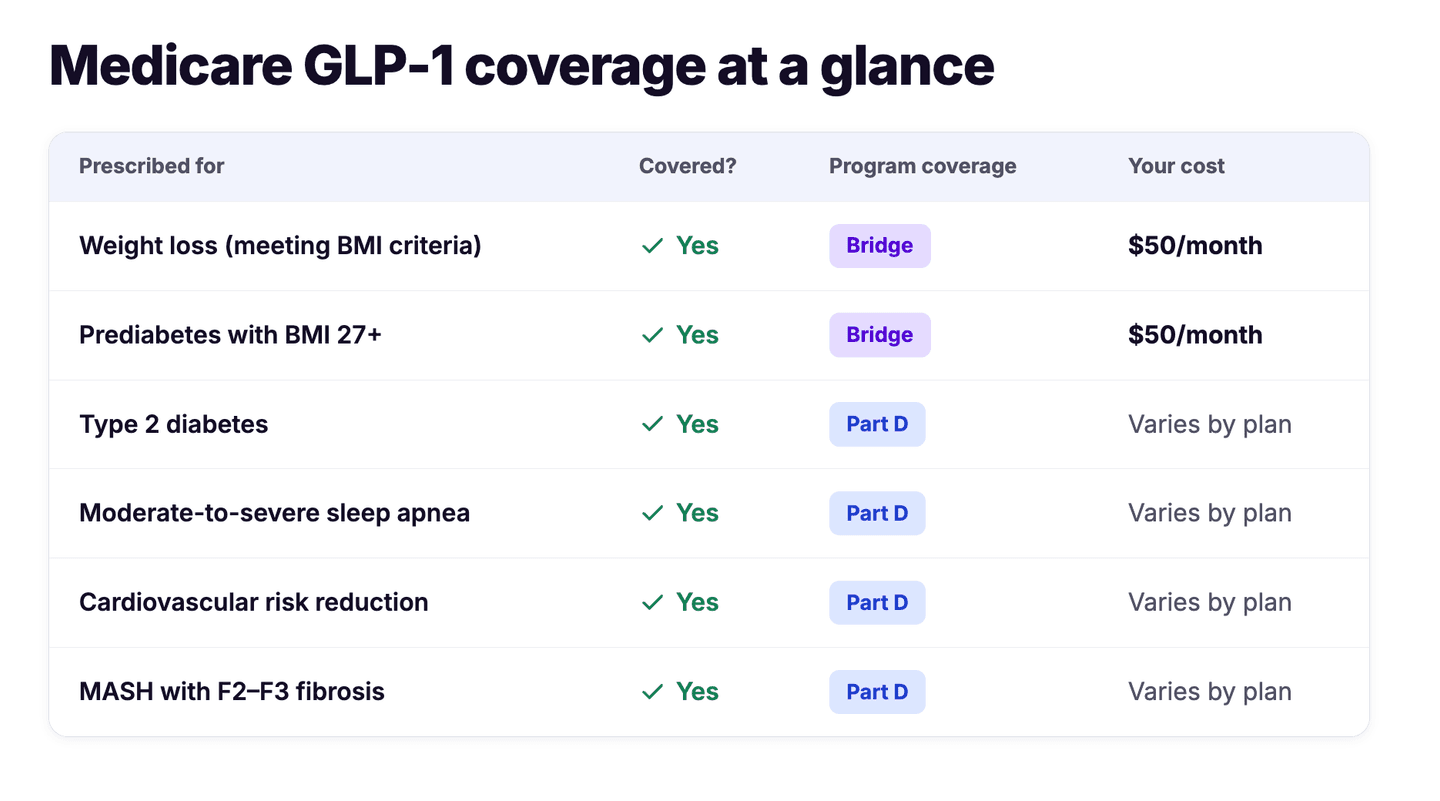
Medicare GLP-1 coverage at a glance
Does Medicare cover GLP-1 for weight loss?
Yes. As of July 1, 2026, Medicare covers FDA-approved GLP-1 medications specifically for weight loss through the Bridge program. This is the first time Medicare has covered weight loss drugs for weight loss specifically, and it's available nationwide. If you meet the eligibility criteria outlined above, you can access Foundayo, Wegovy, or Zepbound for a flat $50 monthly copay.
Does Medicare cover GLP-1 for prediabetes?
Yes. Pre-diabetes is a qualifying condition under the Bridge program for beneficiaries with a BMI of 27 or higher. An important distinction: a prediabetes diagnosis qualifies you for the Bridge program, while a Type 2 diabetes diagnosis is covered under Part D, instead.
Does Medicare cover GLP-1 for diabetes?
Yes, but not through the Bridge program. GLP-1 medications for type 2 diabetes have been covered under Medicare Part D for years. If you have type 2 diabetes, you’ll get coverage for a GLP-1 through your Part D plan (with monthly copays that vary based on your plan).
Does Medicare cover GLP-1 for sleep apnea?
Yes, but not through the Bridge. GLP-1 medications for moderate to severe obstructive sleep apnea are covered under Medicare Part D. If you have a moderate to severe OSA diagnosis, you’ll get coverage for a GLP-1 through your Part D plan (with monthly copays that vary based on your plan).
Does Medicare pay for GLP-1s? What you'll pay
Here's the cost picture, broken into two parts: the medication and the care.
Your GLP-1 medication: $50 a month
Through the Bridge program, eligible beneficiaries pay a flat $50 monthly copay for their GLP-1 medication. No matter which of the three covered drugs you're prescribed — Foundayo, Wegovy, or Zepbound — the cost is $50 per month, regardless of your dose. It doesn't change as your provider adjusts your dosage up or down.
Because the Bridge program operates outside of Part D, there are a few things to know about how the $50 copay fits into your overall drug costs:
- The $50 does not count toward your Part D deductible. Even if you haven't met your annual deductible, you still pay only $50 for your GLP-1.
- The $50 does not count toward your Part D true out-of-pocket (TrOOP) spending or your $2,100 annual out-of-pocket cap. It's an entirely separate cost.
- Low-income subsidies (Extra Help / LIS) do not apply to Bridge claims. Since the Bridge program operates outside of Part D, the reduced cost-sharing you might receive through Extra Help doesn't apply here. The copay is a flat $50 for everyone.
- No opt-in required. Your Part D plan doesn't have to do anything. You don't need to register or sign up for the Bridge program separately. If you're eligible, your provider submits the prior authorization to CMS's central processor, and your pharmacy fills the prescription.
Your Bold appointment: most patients pay $0
Your Bold Care appointments are covered separately from the medication, and are also covered by Medicare and other insurance plans.
78% of Bold patients pay $0 out of pocket for their appointment. Bold providers are in-network with Medicare, UnitedHealthcare, Aetna, Anthem, Blue Cross Blue Shield, and more. For the small percentage of patients who do have a payment responsibility, it's usually a modest copay for a virtual visit. And there are no membership fees or subscription costs — ever.
Bold bills your insurance directly and confirms your cost estimate before anything is booked. No surprise bills here! Your Care Coordinator can walk you through the specifics of your plan so you know exactly what to expect.
Deciding whether GLP-1s are right for you
Cost is one part of the equation. The other part is whether a GLP-1 medication is actually the right fit for your body and your goals. Many patients have questions — about side effects, about being on medication long-term, about whether they'll need the medication forever. These are real concerns, and they deserve a real conversation.
That's what your first appointment with a Bold provider is for. Together, you'll talk through your health history, your goals, and whether medication makes sense as part of your plan. It's a shared decision. Your provider will give you the information you need, and you'll decide together what feels right. If a GLP-1 isn't the right fit, Bold's weight loss program works without medication, as well. Our appointments are 45 minutes long, so you have enough time to really dive into the details.
Learn more about appointment costs.
How to access GLP-1s through Bridge
The Bridge program covers the cost of the medication. But how you access the GLP-1s, and what comes with the medication, varies a lot depending on where you get your care. Here's what the landscape looks like.
Through a comprehensive provider like Bold
Bold helps eligible members access GLP-1s through the Bridge program as part of a doctor-supervised weight loss program built specifically for adults 65 and older. Your medication is one piece of a larger personalized weight loss plan that includes nutritional guidance, strength training, sleep support, and stress management.
Through a comprehensive provider like Bold, your GLP-1 costs $50 per month, covered by Bridge. Bold appointments are covered by Medicare, and 78% of patients pay $0 out of pocket. There are no membership fees.
Your provider monitors your dosage and side effects, adjusts the plan as your body changes, and helps you build habits that will keep the weight off even after you stop taking the medication. Appointments are available in days, not weeks, and follow-ups are covered by insurance.
Through your primary care physician
Your PCP can prescribe through the Bridge program too. Through your PCP, your GLP-1 costs $50 per month through Bridge. But most primary care physicians don't provide exercise programming and nutritional support alongside their medication. Your PCP refers you to specialists for different reasons. Think of a comprehensive provider like Bold as the specialist for weight loss: a provider with the time and the focus to help you build a real plan alongside your medication, working with your existing care team rather than replacing it.
Through an online medication-only program
Online GLP-1 programs have grown quickly over the last few years, and GLP-1s through an online provider will also cost $50 per month through Bridge. But it's worth understanding what these include, especially if you're 65 or older.
Most online programs are not designed for older adults. They typically don't account for the fact that when older adults lose weight quickly, up to 25% of that weight loss can come from lean muscle mass — the very things that keep you strong, balanced, and independent. A program that helps you drop pounds but doesn't protect your muscle mass can leave you lighter but weaker, with a higher fall risk and less strength than when you started.
Some online programs charge $149 per month or more in membership fees on top of your medication cost. And most don't offer the personalized strength training, nutritional support, or lifestyle care that research shows makes weight loss more effective and more sustainable.
How Bold uses the Bridge program — and why medication is only part of the plan
Bold helps eligible members access GLP-1 medications through the Bridge program. But the medication is part of a larger, comprehensive weight loss program. The Bridge program was built with the expectation that medication is part of a broader plan, not the whole plan. In addition to medication (if appropriate), Bold’s weight loss program addresses what we call the Core Four, or the four pillars of effective weight loss for older adults, as well as any side effects from a GLP-1:
Nutrition. Your provider sets protein targets based on your weight, health conditions and kidney function, and helps you build an eating plan that builds muscle while losing fat. This isn't about diets or restriction — it's about eating the right foods for your body. No calorie tracking. No meal logging.
Exercise. Every member receives a personalized exercise program with resistance training routines (including both seated and standing options) designed to build strength while you lose weight. These aren't generic one-size-fits-all plans — they're built for your body, your mobility level, and your goals. Additional fall prevention routines are included as needed.
You can see an example of an exercise class here:
GLP-1 Strength Training: Squats and More
Bold's head trainer, Alicia Estrada, leads a lower-body strength class that can help seniors on GLP-1s maintain muscle mass as they progress in their weight-loss journey.
Sleep. Poor sleep raises cortisol and disrupts the hormones that regulate appetite and metabolism, quietly undermining everything else you're working on. Your provider treats sleep as part of the holistic weight picture, including screening for sleep apnea if needed.
Stress and mental health. Licensed clinical social workers are available as part of your care team. If stress is affecting your day-to-day life, start with our guide to stress in seniors: symptoms, causes, and relief tips that work.
Side effect management. If you're on a GLP-1, your provider monitors your dosage, manages any side effects that come up, and adjusts the plan as you go.
Bold's program is designed so you can get the weight off and keep it off, even after stopping medication. If medication is appropriate, you and your provider will work together to find the right dosage for weight loss and, eventually, the right timing for tapering off.
Learn more about how Bold's weight loss program works.
How to access GLP-1s through the Bridge program with Bold
Getting started with Bold is easy.
- Check your coverage. Visit agebold.com/weight-management and answer a few questions about your insurance and your health goals. It takes about two minutes. Bold's team verifies your coverage and confirms your cost estimate before anything is booked, so you know what to expect before your first appointment.
- Have an Intake Call with your Care Coordinator. During your free intake call, your personal Care Coordinator will walk through a few questions to get a sense of your goals and match you with the right provider. If you have questions about insurance, cost, or what to expect, this is where they get answered. Every Bold patient gets a dedicated Care Coordinator who stays with you throughout your program.
- Meet your provider virtually. Your first visit is a 45-minute telehealth appointment with a board-certified doctor or nurse practitioner who specializes in weight loss and lifestyle medicine for older adults. You'll discuss your health history, your daily habits, and where you want to feel better. Your provider builds a personalized Weight Loss Care Plan, and together, you'll decide whether a GLP-1 medication is the right fit for your body and your goals.
- Bold handles the paperwork. If you are prescribed a GLP-1, your Bold provider sends the prescription to your pharmacy. Once the pharmacy submits it to the Bridge program, Bold completes the required prior authorization, documents your eligibility, and coordinates with your pharmacy. Approval usually takes several days. Once approved, you stay approved through the end of the program, including refills and dose changes, as long as you stay on the same medication. From there, you pick up your prescription each month and pay the $50 copay.
- Start your program and follow up. Your care team stays with you — checking in on your progress, adjusting your dosage if needed, managing any side effects, and updating your nutrition and exercise plan as your body changes. Follow-up appointments are covered by insurance, and you can meet with your provider as often as you need. Your weight loss plan evolves with you.
Ready to find out if you're eligible?
If you're on Medicare and interested in losing weight safely, the Bridge program may make GLP-1 medications more affordable than you expected. And Bold can help you access it as part of a weight loss program that's actually built for your body — one that protects your muscle, your balance, and your independence while helping you lose the weight.
Checking your coverage takes about two minutes.
Check Eligibility
Book an appointment with a Bold Care provider to lose weight, reduce pain, and get your energy back. Covered by Medicare.
Questions? Call a Bold Care Coordinator at (424) 577-5266, Monday through Friday, 5am–5pm PT, or email careteam@agebold.com.
Frequently asked questions about the Medicare Bridge program
Possibly, yes. Bridge eligibility is based on your BMI and health conditions at the time you started GLP-1 therapy, not where you are today. If you met the criteria when you began, your provider can attest to that in your prior authorization. One exception: if you've gotten your GLP-1 through your Medicare Part D plan, you aren't eligible for Bridge and should keep getting it through your plan.
Bold's weight loss program is designed to build a foundation of healthy habits (the Core Four) that support long-term weight management, including if you and your provider later decide to change or stop medication. If you and your provider decide it's time to taper, they'll help you do it safely while protecting your progress.
Bold Care is currently available to Medicare members in Texas, California, Florida, and Pennsylvania, with more states on the way.
Per month.
Through December 31, 2027.
Bold's weight loss program works with or without medication. If you don't qualify for a GLP-1 through the Bridge, your provider will build a plan around nutrition, exercise, and lifestyle changes — and it's still covered by Medicare. You can also start on your own with our guide on how to lose weight as a senior.
Yes — any eligible provider can submit a prior authorization through the Bridge. But most PCPs don't have the time to build a comprehensive weight loss plan alongside the prescription. Bold offers the medication as part of a full program: nutrition, exercise, sleep, and ongoing provider support.
No. Once your prior authorization is approved, you don't need a new approval as long as you stay on the same medication through December 31, 2027.
No. Because the Bridge operates outside of Part D, low-income subsidies don't apply. The copay is a flat $50 for everyone, regardless of LIS status.
The Bridge program does not cover Ozempic. The Bridge program covers only Foundayo, Wegovy (injection or tablet) and the Zepbound KwikPen. Wegovy is the same active ingredient as Ozempic (semaglutide), so it is the closest Bridge-covered option.
No. You need to be enrolled in an eligible Part D plan, which includes most standalone drug plans and Medicare Advantage plans with drug coverage.
No. Those conditions are already covered under Medicare Part D, so you're ineligible for the Bridge program — even if you otherwise meet the BMI criteria. If you're already getting a GLP-1 through Part D for diabetes or moderate-to-severe obstructive sleep apnea, you should stay on that pathway. Bold can help you access GLP-1s under Part D the same way it helps with the Bridge.
Yes. As of July 1, 2026, eligible Medicare beneficiaries can access FDA-approved GLP-1 medications for weight loss through the Medicare GLP-1 Bridge program for a $50 monthly copay.
Bold Care is an in-network provider for eligible Medicare, UnitedHealthcare, Aetna, Anthem, and Blue Cross Blue Shield plans, and more. Member copay amounts are $0 for covered services under qualifying plans. Benefits, eligibility, and coverage details are subject to individual plan terms and may vary. This is not a guarantee of benefits and does not constitute an official plan document. Contact your plan or Bold Care to confirm your specific coverage. Bold Care is not a replacement for your primary care provider.
Weight loss for seniors
Book an appointment with a Bold Care provider to lose weight, reduce pain, and get your energy back. Your plan includes nutritional support, exercise programming, and $50 monthly copay FDA-approved GLP-1s, if prescribed.
More from Bold

Webinar: Intro to Bold Care's Weight Loss Program
Watch this webinar to learn more about Bold's weight loss program, covered by Medicare, and how you can get started.

Are GLP-1s safe for older adults? What you need to know about weight-loss medications over 60
Learn about GLP-1s and aging, plus how to pair medication with lifestyle changes for weight-loss success.

Do I qualify for GLP-1s through Medicare?
Medicare now covers FDA-approved GLP-1s for $50 per month for eligible members. Learn more about Medicare coverage of GLP-1s for seniors with Bold Care.