Getting stronger, losing weight, and doing more: A conversation with Bold Care’s Christa Steffensmeier
Key takeaways
- After your 30s, you lose about 5% of your muscle mass per decade — but that only happens if you're not actively working to prevent it. You can rebuild muscle at any age.
- Losing weight without building strength can leave you lighter on the scale but not actually healthier. Blood pressure, blood sugar, and cholesterol matter more than the number alone.
- Eating too little backfires. Dropping under 1,000 calories a day can slow your metabolism and stall your progress. Strategic snacking and more protein throughout the day are a better path forward.
- You don't need a gym or an hour-long workout to get stronger. Simple movements like chair marches, counter push-ups, and arm circles, done consistently, make a real difference.
A Bold Care provider can help you put all of this together. Appointments are 45 minutes and cover nutrition, movement, sleep, and stress, so you leave with a plan that fits your life. Check your eligibility to get started.
For many adults over 65, weight can start to feel like a moving target. You may be eating the way you always have, staying reasonably active, and still noticing changes in your weight, your energy, and how your body feels day to day.
One reason behind these changes can be muscle loss. Starting in your 30s, your body gradually loses muscle mass, and that change affects metabolism, energy, and strength in ways that the scale alone doesn't capture. Strength training for seniors to maintain muscle mass, combined with how you eat, how you sleep, and how you manage stress, also plays a role in your weight.
Understanding what's driving these changes, and what to do about them, is precisely what Christa Steffensmeier, one of the nurse practitioners at Bold Care, spends her days helping patients work through.
Christa practices lifestyle medicine with Bold Care. Lifestyle medicine is an approach that examines your daily habits and how they influence how you age. In our conversation with Christa, she shares what she tells her own patients about building strength, managing weight, and finding a starting point that actually fits your life.
Weight loss: Not the full story
Q: Talk to us about what happens to muscle as we age, and why does it matter?
After your 30s, you start losing an average of about 5% of muscle mass every decade. When you lose muscle mass, your metabolism decreases, which makes it more difficult to lose or even maintain your weight, even if you’re eating the same things you were ten or twenty years ago.
Muscle loss also affects how strong you feel functionally day to day. People who are consistent with strength training – movements that build muscle, like resistance exercises, walking, or even chair-based workouts – tend to feel better overall; more energy, better mood, and more confident moving around. And that matters just as much as what the scale says.
Q: What can happen if someone focuses only on weight loss and not strength?
The number on the scale can be deceiving. A lot of people work hard to lose weight without realizing they're losing muscle in the process, not just fat, and then they're not as strong and healthy as they expected to be. You may hit your new goal weight, but your cholesterol, blood pressure, and blood sugar haven’t improved. So the goal is really to figure out where you're feeling strong and healthy, and not to fixate on the number on the scale.
Q: So, is it possible to rebuild muscle after losing it, even later in life?
Absolutely. You can increase your muscle mass at any age. It's about figuring out what types of movement work for you and being consistent with them. Just because you haven't had a background in strength training or exercise in general, it doesn't mean you can't start now. And that 5% per decade loss is what happens when you're not doing anything to prevent it. If you've been active your whole life and continue through your 70s and 80s, there's no reason you can't maintain that muscle mass or continue to build it.
Q: What does getting stronger actually look like? And how should people think about progress beyond the scale?
Getting stronger looks different for every person. Maybe right now you have to use a walker full-time. Building strength might mean you're eventually comfortable walking around your own home without a fear of falling, and that's a huge improvement in your quality of life.
Or maybe you go for a one-mile walk every day but feel tired the rest of the day. Getting into a more balanced routine might mean you can eventually get out for several-mile walks, or try hiking, or add cycling. That’s a huge improvement!
We call these non-scale victories, and they're significant. Are you able to go for that walk and feel good afterward, instead of exhausted? Can you bend down to get something from the refrigerator without pain? Can you get out of the car without feeling hunched over? Those all count. So does getting blood pressure under better control, or seeing your A1C come down out of the pre-diabetes or diabetes range. Maybe you wanted to lose fifty pounds, and you lost twenty-five — those twenty-five pounds can have a huge impact on your blood sugar control. You can be at a higher weight than you were as a young adult and still be healthier than you've been in years.
Bold Care
Lose weight, reduce joint pain, and wake up with more energy. 86% of Bold patients pay $0 out of pocket.
Nutrition for strength and weight loss
Q: Let’s talk about eating, weight loss, and strength. Where do you start when helping someone?
When we're talking about improving nutritional habits for overall strength and health, you figure out where someone is at and make changes from there. Most people need more protein. If you ask them, they say they eat protein every day, but it's just a piece of chicken with dinner.
So the first step is to balance out the three main meals of the day, making sure you’re getting in all your protein and a good portion of vegetables and fiber. Once that’s a habit, start adding in a mid-morning snack, and then a mid-afternoon snack.
It’s important to make changes slowly though, and build habits that will stick. We meet people where they’re currently at regarding their nutrition, choose one small eating habit to build or change, and then keep moving forward from there.
Q: In your professional opinion, what should a typical day of eating look like?
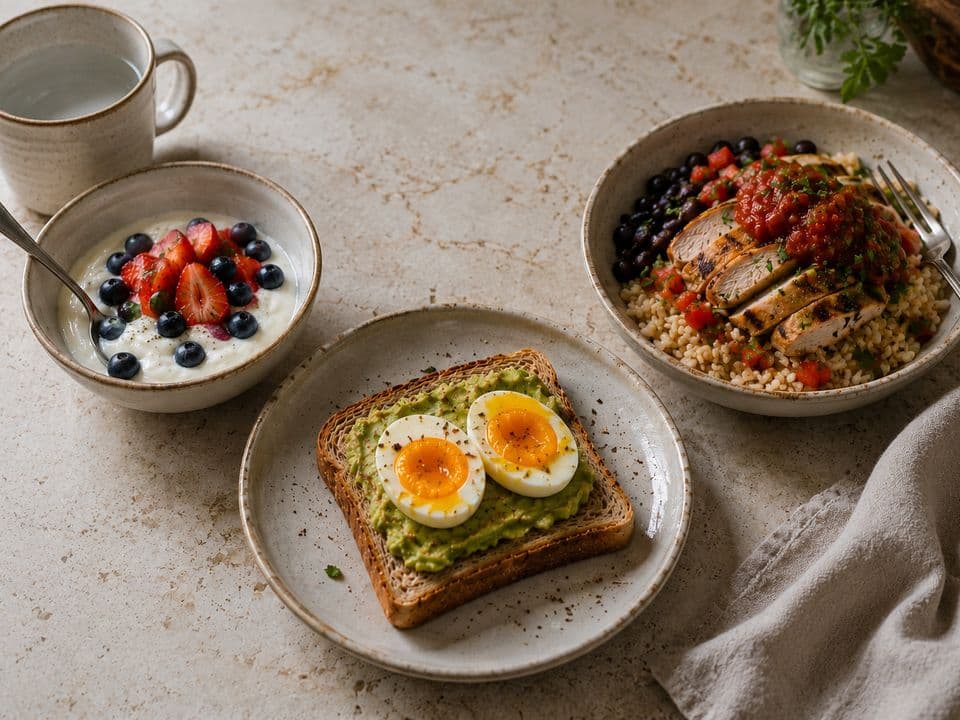
In a perfect world: three meals, a mid-morning snack, and a mid-afternoon snack. For example, for breakfast, an egg scramble with vegetables, a little cheese, and a slice of sprouted bread gives you protein, healthy carbs, and fat. That combination keeps you full for a long time. Most people eat carb-heavy breakfasts and then are hungry again within an hour.
For a mid-morning snack, something like an apple with a tablespoon of nut butter. You’ve got carbs, fat, and protein. Lunch could be a high-fiber, low-carb wrap packed with protein and as many vegetables as you want. For a mid-afternoon snack, Greek yogurt or low-fat cottage cheese with a serving of fruit. Dinner: a serving of lean protein, a whole grain like brown rice, lentils, or quinoa, and as many colorful vegetables as you want. No provider is ever going to tell you to cut back on colorful vegetables.
Q: You’ve mentioned snacking. What are snacks actually doing for you? Aren’t they something to avoid?
Snacks are kind of like a secret weapon. It’s counterintuitive to snack, but pre-planned, high-protein snacks help properly fuel the body and maintain energy levels throughout the day.
When I say “snacks,” I mean purposeful snacks between breakfast and lunch, and between lunch and dinner, so that when you get to your next meal, you’re not overly hungry and overeating. A lot of people don’t eat enough in the morning, and their hunger is out of control by dinnertime, and nothing feels like enough. Planned snacks help maintain that feeling of fullness and keep your energy and blood sugar more even throughout the day.
Q: What are the most common nutrition mistakes you see?
I see a lot of people who try to lose weight and stop eating enough. People will try to diet by eating under a thousand calories a day, and then they can't understand why their weight isn't improving and they're exhausted all the time. When you restrict too much, your body essentially reverts to a kind of deprivation mode where the metabolism slows down to match whatever you're feeding it.
The other common mistake is going high-protein, low-carb, and leaving out the fruits, vegetables, and whole grains. This isn't about restriction; it's about eating the right foods for you. Think about the Mediterranean diet, but with a higher protein amount. This approach supports muscle mass, weight loss, and helps bring down overall inflammation.
Moving for strength, even if you don’t “work out”
Q: How do you talk about strength training with someone who doesn’t see themselves as someone who exercises?
Everybody can start somewhere. A lot of people are intimidated by the gym, so unless that's already your normal, it's not where I'd recommend beginning. You can start with something as simple as grabbing a couple of canned goods from your pantry and doing bicep curls. That seems like nothing, but when you're doing it consistently through the week, you're going to build strength.
If exercise feels intimidating, I tell people: Start with something small for five or ten minutes and build a habit first. Once that feels comfortable, add another five minutes. If five minutes feels like too much, do two minutes. The idea that a workout has to be an hour to be worth something is false.
Q: What are some easy movements people can work into their daily lives that help build strength?
There are more than most people realize. Simple, easy movements. Chair marches — sitting with your feet on the floor and lifting your knees slightly — will get your heart rate up after a sustained five minutes. Arm circles build shoulder strength and double as cardio. You can do counter push-ups, where you push against an elevated surface rather than the floor, or calf raises while holding onto a countertop for balance. Even a regular stretching routine improves mobility, which makes everything else easier over time.
Once those smaller movements start to feel easier, that’s a good time to start building on them. A Bold Care provider can help you figure out what kind of movement routine actually fits your life and your specific health goals, so you're not guessing at what to try next.
Q: How much movement does someone actually need to start seeing a difference?
Even going from zero to an hour total per week, you’ll start to notice something. The standard recommendation is a minimum of 150 minutes per week, and that's a great goal to work toward, but maybe not the place to start. Moving for 45 minutes every week consistently beats doing an hour one week and then nothing for two weeks. Any amount helps long-term. Don't write off five minutes a day as not worth it.
Lifestyle medicine and how it helps
Q: What is lifestyle medicine, in simple terms?
Lifestyle medicine is working on all of the controllables in your life — things you generally don't get the chance to talk through with your primary care provider because they're focused on medication reviews, labs, and procedures. Lifestyle medicine is figuring out: what works for me to add more movement? What can I do to sleep better? It's really about helping people take more control over their health with the things they're actually in control of day to day.
Q: How do you approach working on all of these areas at once without it feeling overwhelming?
They're all connected. Some people come in with solid habits around food and exercise but they're not sleeping well or they're under a lot of stress. All of that raises cortisol, which makes it harder to see the results of the work you're putting in. If you only address one area, you're not going to get the overall change you're looking for.
Q: If someone wanted to start improving how they feel today, where would you suggest they begin?
Choose one small thing and make it a habit. A five-minute walk. Five minutes of stretching at another point in the day. If you're skipping a meal, add just a snack at that time to prime your body to expect food at regular intervals. Just start there. It doesn't need to be as overwhelming as most people make it. Start small, stay consistent, and build from there.
When to talk to a provider
Q: When does it make sense to get additional support?
Very few people at any age have it all figured out. If you have a question and you're not sure whether you can improve something, make an appointment. If there's a specific area you're struggling with — sleep, a big life change, weight, balance — we're here for all of those things. Bold Care appointments are 45 minutes long, giving you the time to actually focus entirely on those lifestyle factors.
Q: What does a first Bold Care appointment actually look like for someone coming in with weight and strength concerns?
We go through all of these areas together: exercise, nutrition, sleep, stress, etc. We talk through your current baseline: how much are you moving, what are your eating habits like, how's your sleep, and your stress levels? Because if something's off in one of those areas, it can undermine everything else you're doing. From there, we talk about what realistic changes look like for your specific life, rather than giving you a generic recommendation. And then we check in every month or so: what's working, what's been a struggle, what to add next.
Some people come in and they're honestly already doing most things right. That's fine too. Sometimes you just want to bounce ideas off someone and get a sense of what to try next. Your Bold Care provider can work alongside your existing care team.
Ready to build your own plan?
If this conversation made you think about your own habits, this is the place to begin. A Bold Care appointment is a chance to have this kind of conversation with a provider who has the time to really listen — and to leave with a realistic plan that's built around your life, not a generic handout.
Are you ready to feel stronger and do more? Check if you’re eligible for Bold at no cost through your health plan and start building your habits today.
More from Bold

Protein for seniors: How to get more and why it’s important
Protein for seniors is important for healthy aging. Learn how to get more protein and the best high-protein foods to try.
The protein guide for adults 60+
Learn how much protein adults over 60 really need, the best high-protein foods to eat, and simple ways to hit 80 to 100 grams a day without overhauling your diet.

Nutrition webinar: Eating for functional health
Watch this webinar with registered dietitian Janice Baker to discover how the right foods can help you manage chronic conditions like diabetes, chronic pain, and arthritis.