Why Food Logging Works
Logging your meals is about turning guesses into useful information, not about restriction. See what the research says, why a rough entry is better than none, and how your Bold Care team uses your log to support you.

Most of us think we have a pretty good handle on what we eat. But memory is a fuzzy thing. A handful of almonds here, an extra splash of olive oil there, or a weekend that drifts off plan, it all adds up, yet rarely registers in our mental tally. Food logging eliminates the guesswork. It isn't about restriction or judgment; it’s simply about turning assumptions into clear, actionable data so you can ensure your daily habits actually align with your weight loss goals.
When you log a meal with Bold, we estimate the protein, fat, and carbohydrates in the meal and show how you’re doing against daily targets set by your Bold Care doctor or nurse practitioner. You’ll know where you stand while there’s still time in the day to adjust, whether that means adding some protein to your afternoon snack or feeling good about a day that’s right on track.
Logging is a new habit, but it’s worth the effort, and it’s one of the best-studied ways to eat better. Here’s what the research shows, and how to make it simple.
The most consistent finding in weight-loss research
Research into the benefits of food logging shows that consistency drives results.
In an early landmark study of nearly 1,700 adults working to lose weight, researchers at Kaiser Permanente found that people who kept daily food records tended to lose about twice as much weight as those who kept none.[1] (opens in new tab) Everyone was in the same program, with the same group sessions and the same advice. The people who logged most consistently lost the most weight.
That finding has held up as weight-loss programs have moved onto our phones. A 2019 review of digital food logging also found that people who tracked their intake more consistently tended to lose more weight. [2] (opens in new tab)
Our memory is a little too kind to us
Most of us aren’t great at estimating what we eat, and it isn’t a character flaw. When researchers compare what people say they eat with objective measurements, people tend to underestimate, sometimes by a lot. Bites, nibbles, drinks, and “just a taste” don’t register in memory the way a sit-down meal does.[3] (opens in new tab)
Logging replaces the hazy guesswork with a clear picture. Sometimes it shows that your breakfast is already great, or that your afternoon snack was bigger than you thought. Either way, you’re working from real information instead of a feeling.
It’s a feedback loop, not a report card
Most people don’t struggle with knowing what they should do. The hard part is noticing, in the moment, how things are going. Logging gives you a quick check-in:
- You see a pattern, like a lot of food late at night and not much at breakfast.
- You make one small adjustment, like moving some protein earlier in the day.
- You see the effect the next day and keep what works.
That cycle of noticing, adjusting, and seeing the result is where change happens. It also means the log isn’t a test you can fail. A day that looks different from what you planned is simply information, and it’s often the most useful kind.
It gets faster, and it doesn’t have to be perfect
The biggest worry we hear is time. One study followed people over six months and found that those who kept logging got much faster at it, from roughly 23 minutes a day in the first month to about 15 by month six.[4] (opens in new tab) You get quicker because your regular meals become familiar, and regular logging becomes a normal part of your routine instead of a chore.
You also don’t need to weigh every almond. Consistency matters more than precision. A rough entry made every day does more for you than a perfect entry made twice a week.
What it looks like on Bold
Each meal you log adds to a running picture of your day, so you can see where your protein, fat, and carbohydrates stand against your targets.
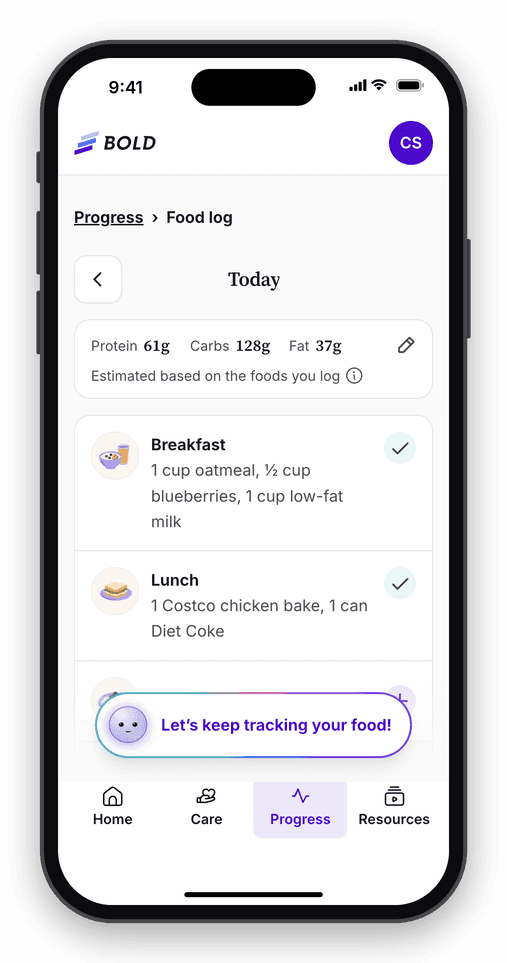
Here’s why that matters:
- You can catch a protein gap in time. Seeing where you stand at lunch leaves time to adjust at dinner.
- You see how your meals fit together. Fat and carbohydrates appear alongside protein, so you get a full picture of the day instead of a single number.
- Your care team can work with real data. Instead of advice based on a rough recollection of last week, your clinicians can tailor guidance to what’s actually happening.
- You can see progress. Over weeks, you’ll watch your own habits shift
“But what about…?”
“I don’t have time.” Log the meal right after you eat it, when it’s fresh. It’s much quicker than rebuilding the day from memory at night, and it gets faster with practice.
“I eat out a lot.” An estimate is fine. Log the closest match and move on. A rough entry is far better than a blank.
“I forgot yesterday.” Skip it and log today. One missed day doesn’t undo anything, and the benefits come from the overall pattern.
“I don’t want to obsess over food.” That’s a fair concern, and we take it seriously. Logging is meant to be a quick, neutral check-in, not a source of stress or guilt. If tracking ever starts to feel stressful or consuming, tell your care team. Logging helps many people, but it isn’t right for everyone, and we’d rather adjust the plan than have you push through.
How to start
- Log the next meal you eat, not a perfect day. One entry counts.
- Log in the moment whenever you can.
- A rough entry beats a skipped one. You can always refine it later.
- Look at your protein number once a day. If you only pay attention to one thing, make it that one.
- Give it two weeks. The first few days feel slowest. Most people say it becomes routine faster than expected.
We’re asking for a few minutes a day because we think it’s one of the most effective things you can do, and because we’ll be right there using that information to support you.
Weight loss for seniors
Book an appointment with a Bold Care provider to lose weight, reduce pain, and get your energy back. Your plan includes nutritional support, exercise programming, and $50 monthly copay FDA-approved GLP-1s, if prescribed.
More from Bold

Nutrition for women over 60: the complete guide to eating well after menopause
Learn about nutrition for women over 60, including insight on protein, nutrition for weight loss, bone health, heart health, cognitive health, hormone balance, and more.

Does Medicare Cover GLP-1s for Weight Loss? The Medicare GLP-1 Bridge Program Explained
Medicare now covers certain FDA-approved GLP-1 weight loss drugs for eligible beneficiaries, for a $50 monthly copay. Here's how the Medicare GLP-1 Bridge program works, who qualifies, and how to access it.

Webinar: Intro to Bold Care's Weight Loss Program
Watch this webinar to learn more about Bold's weight loss program, covered by Medicare, and how you can get started.