Stars changes put mental health at the center of MA quality strategy
Medicare Advantage Quality and Stars leaders need to place a renewed emphasis on strategies to improve members’ mental health, including year-round member engagement, integration with clinical initiatives, proven behavior change tools, and holistic HOS solutions.

The 2027 Final Rule confirmed that CMS is pushing health plan leaders to focus on longitudinal care, functional health outcomes, and member experience. If your health plan is not prepared to pivot, your Part C Star Ratings could take a hit.
With 11 administrative measures removed, it’s time to recalibrate your Stars strategies to focus on higher-weighted measures, year-round engagement, and overall member experience. One key shift: mental health is becoming an important lever for quality and overall Star Ratings with a new measure, heavier weighting, and a tighter emphasis on outcomes.
What’s changing in Stars for mental health, and why it matters
There are two major shifts taking effect in the 2027 measurement year in Part C Ratings that emphasize the growing importance of mental health for Medicare Advantage.
- A new Depression Screening and Follow-Up Measure will be added “to address behavioral health gaps” starting in the 2027 measurement year and 2029 Star Ratings, as announced in the Final Rule. This measure will track the percentage of members screened for depression using a standardized tool like the PHQ-9 who receive follow-up care within 30 days.
- Measure C05: Improving or Maintaining Mental Health was reintroduced in the 2026 Star Ratings through the Health Outcomes Survey (HOS) after first being put on display during the COVID-19 pandemic. Beginning in 2027, C05 is triple-weighted. The 2026 Star Average was 3.2, signaling an opportunity to turn this into a positive driver for overall Stars.
Behavioral health quality measurement has long been a challenge for plans, with low data capture and a tendency to treat access as a proxy for impact. CMS is now measuring what happens after screening to close gaps in care, and amplifying the importance of what members say about their own mental health over time. That changes the playbook for Stars and Quality leaders.
Accelerating access to mental health support for MA members
Better Medicare Alliance found that rates of depression screenings are 18 to 27 percent higher in Medicare Advantage compared to traditional Medicare. This carries the promise that MA beneficiaries are indeed getting screened for depression and anxiety through standardized tools like the PHQ-9 or GAD-7.
Importantly, the new Stars measure won’t reward screening volume but follow-through and gap closure. Your care coordination workflows need to move members from a screening to documented care, fast. That means pressure-testing your referral pathways, provider workflows and availability, and member-facing engagement and communications campaigns now.
Tackling the hard-to-move triple-weighted HOS mental health measure
Star Ratings measure C05: Improving or Maintaining Mental Health is based on self-reported feelings of depression, anxiety, loneliness, and fatigue. Questions posed to members in the HOS to drive this measure are focused on energy levels, if “emotional problems” have impacted work or social activities in the past four weeks, and how members would rate their mental health today compared to one year ago.
With the two-year timeframe the HOS is administered on and a focus on perception, plans have long struggled to identify – and measure – what actually works to move the needle on the HOS. At Bold, we’ve been partnering with leading plans to solve this, gathering insights, learnings, and rich data about how to effectively address the HOS.
Here are three considerations for Stars leaders working the triple-weighted measure.
→ Treat the HOS as a connected system, not five separate measures. Take bladder control, for instance: urinary incontinence and bladder control issues are linked to depression and decreased independence, and are also a leading cause of falls. One-off interventions on any single measure leave Stars and outcomes on the table. The HOS rewards holistic improvement in members’ health and quality of life, and requires a unified strategy.
→ Engage members year-round. Because the Improving or Maintaining Mental Health measure asks members to compare their mental health to a year ago, point-in-time outreach or standalone campaigns won’t move it.
“Wellbeing isn’t a seasonal trend, it’s a daily practice,” explains Anima Banks, Bold’s Head of Partnerships and Chief of Staff. “By helping our members make small, positive changes 24/7/365, we give them the agency and confidence to feel better both mentally and physically, and improve their perception of their health.”
→ Speak the HOS’s language. Member engagement and messaging should mirror the survey’s framing – including language around energy, mood, emotional well-being, and how mental health shows up in daily life – so your members recall the mental health support they’ve received from their plan when surveyed.
Connecting the dots: The mind-body connection
Research shows self-perceptions of health worsen with age, and members reporting higher rates of depression and anxiety tend to report worse overall health. But this connection between mental and physical health works positively as well. Regular physical activity reduces anxiety and depression, improves sleep quality, and builds the strength, balance, and endurance that drive a member’s sense of agency and independence.
Most exercise programs for Medicare Advantage are known for low adherence, but digital programs that pair personalized, accessible movement with behavior-change tools and education can produce lasting engagement – especially when the experience meets older adults where they are.
“Older adults face numerous barriers to staying active – pain limitations, time constraints, lack of motivation, and uncertainty about what movements can help or hurt,” says Chris Lloyd, Director of Product at Bold. “Bold’s programs are designed to break down those barriers, focusing on habit formation. When members engage with Bold, they don’t just move more, they feel more confident in their ability to manage their health, which is key to improving HOS outcomes.”
Improving mental health with Bold’s personalized programs
8 in 10 Bold members report improved mental health (2025 Bold Book of Business)
Bold brings together personalized engagement, habit formation, preventive care, exercise, and education to boost self-efficacy and drive behavior change that transforms how members perceive their overall health – all designed around how the HOS is actually measured.
Bold embeds regular member reflection on their mental health to help keep their emotional state top-of-mind, and encourages increased engagement or action if their mental health is worsening. Our programs share progress trackers and badges tied to activity streaks and milestones to celebrate with members throughout their programs – often cited as a key motivator in member feedback.
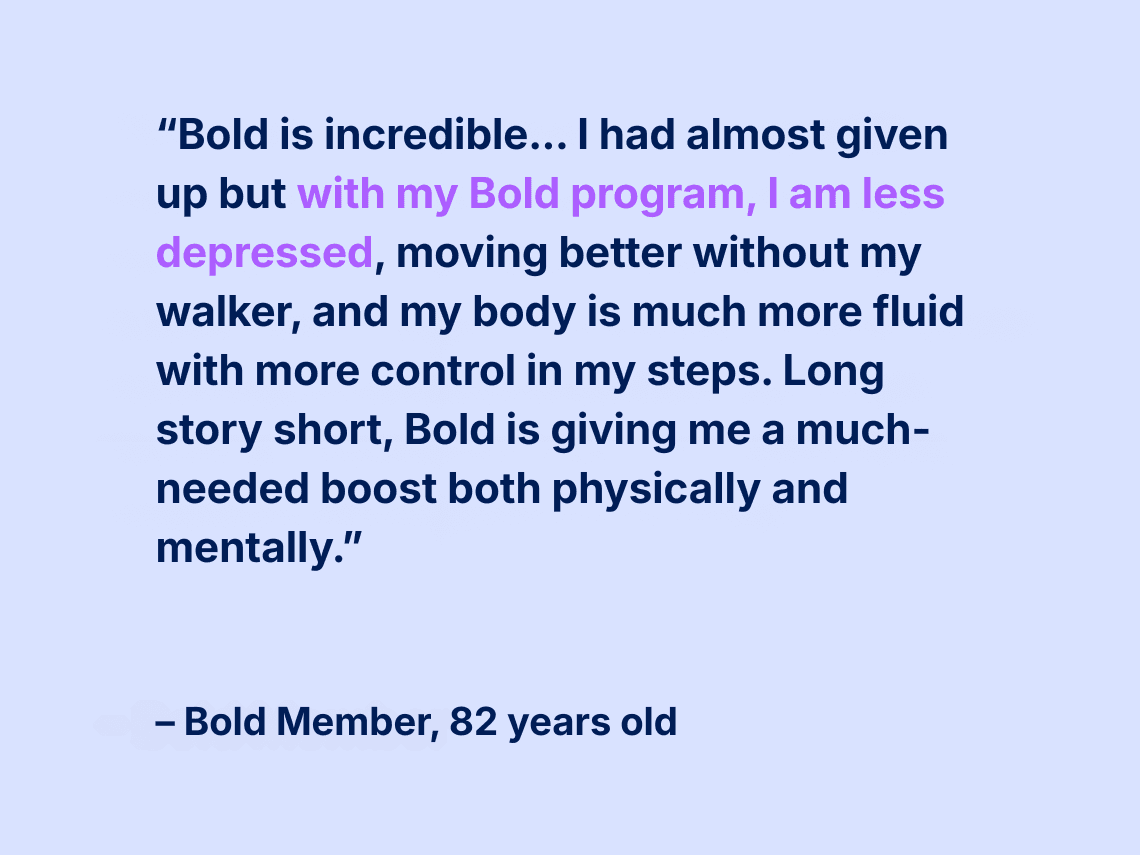
Many Bold members report how surprised they are at the improvement in their mood and emotional well-being only a few weeks into their programs – a result of regular engagement, new healthy habits, and a feeling of progress and greater control of their overall health and quality of life.
The bottom line for Stars leaders
The mental health measures coming into focus for Star Ratings are a critical opportunity for MA plans to cross the 4-star threshold.
Timing is key, and quality leaders who act now will be rewarded in 2027 Stars. With the HOS in the field starting in July, plans have a limited window of time to collect baseline data before the Improving or Maintaining Mental Health measure becomes triple-weighted. You should also re-evaluate your behavioral health benefits now and reconsider your investment in supplemental benefits that can move the needle on mental health.
Quality leaders need to place a renewed emphasis on your strategies to improve members’ mental health, focused on year-round member engagement, integration across clinical and quality initiatives, proven behavior change tools, and holistic HOS solutions.
Book a free HOS consultation with Bold to walk through your recommended action plan with our Stars experts and discuss opportunities for member engagement, supplemental benefits, and interventions tied to mental health and other key measures. Learn more.
More from Bold

Acing the ever-important HOS test: A guide to improved Star Ratings
Higher weights mean higher stakes for Medicare Star Ratings. And that’s especially true for the Health Outcomes Survey (HOS). In Star Year 2027, HOS will contribute close to 15% of a plan’s Star Ratings – doubling the weight of HOS measures in 2022.

Webinar: Intro to Bold Care's Weight Loss Program
Watch this webinar to learn more about Bold's weight loss program, covered by Medicare, and how you can get started.

Are GLP-1s safe for older adults? What you need to know about weight-loss medications over 60
Learn about GLP-1s and aging, plus how to pair medication with lifestyle changes for weight-loss success.