Sciatica stretches: 9 exercises for sciatica relief
Sciatica stretches ease tension in your hamstrings and lower back to improve pain. Try these seated, standing, and floor stretches for sciatica relief.


Reviewed by
Key takeaways
- Sciatica refers to pain, numbness, or tingling that runs from the lower back down one leg. It affects about 40% of American adults.
- Moving your body often helps sciatica improve. Stretches that target the lower back and hamstrings release tension in the areas where the sciatic nerve passes. Up to 90% of people with sciatica get better without surgery.
- Bold's sciatica stretches can be done seated, standing, or on the floor. Seated options like the figure four stretch and the knee-to-chest stretch require no equipment and work for any fitness level.
If you’ve ever felt the sensation of pain radiating from your lower back down one leg, you might be familiar with sciatica. This type of discomfort is common, affecting about 40% of American adults at some point in their lifetime.
The good news is moving your body often helps your symptoms go away. Keep reading to learn some of the best stretches for sciatica relief.
What is sciatica?
Technically, sciatica isn’t a true medical diagnosis. “Sciatica is a symptom of pain, numbness, tingling, or weakness radiating along the sciatic nerve, which travels from your lower back through your buttocks and down the back of each leg,” explains Bold Care provider Dr. Mitul Desai. People commonly use this term to describe symptoms that travel the same path as the sciatic nerve.
What is the sciatic nerve?
The sciatic nerve is the largest nerve in your body. It starts where several nerves in your lower back come together, then extends down your lower back, through your buttocks muscles, and down each leg. It’s involved in moving your legs and also sending signals to your brain about temperature and pain.
Symptoms of sciatica
The symptoms often include:
- Aching, shooting, or burning pain that starts in the lower back or buttock and may radiate down one leg
- Numbness, tingling, electrical sensations, or other nerve-related symptoms in the lower back, buttock, or legs
- Muscle weakness in the legs
Your symptoms may get worse if you bend or twist from your lower back or raise the leg that hurts.
The combination of symptoms known as sciatica earned that name because they typically follow the path of the sciatic nerve. However, sciatica pain can be caused by irritation or compression of the sciatic nerve or other nerves in the spine.
Risk factors of sciatica
“Sciatica is caused by irritation, inflammation, or compression of the sciatic nerve by common causes such as disc herniation or degeneration or narrowing of the spinal canal,” Dr. Desai says. It’s most frequently caused by a herniated disc, sometimes called a slipped disc. This occurs when a disc between vertebrae (bones in the spine) bulges out toward the spinal canal (the tunnel through the center of your spine). The bulging disc then puts pressure on nerves and causes pain.
But other underlying causes and risk factors can also be at play.
Your age
“As we age, gravity is a constant, so it wears and tears on the lower back,” Dr. Desai says. These age-related changes to the spine can contribute to a person’s risk of a slipped disc or other related issues, such as the narrowing of the space around the spinal cord, called spinal stenosis. These changes can contribute to sciatica in older adults, especially those with osteoarthritis in the spine.
Injuries or diseases
Injuries to the bones or muscles in or around your buttocks can compress nerves in your back, as can tumors or infections, which are more rare.
Your profession
Certain careers are associated with a higher risk of sciatica. If you’re required to operate machinery, sit for long periods of time while driving, or move your body in awkward or uncomfortable ways, you might notice this back and leg pain.
When to talk to a doctor
If you think you might have sciatica, it’s generally OK to try to address your symptoms at home first. You can apply ice to the area that hurts and try over-the-counter non-steroidal anti-inflammatory medications like ibuprofen, as long as they’re safe for you.
But if these home methods don’t help after a few days, talk to a doctor. They’ll ask you about your symptoms and your medical history, and they’ll examine your back. They might refer you for some imaging tests, like X-rays or an MRI.
You should also talk to a doctor if your pain is sudden or severe or if you have any numbness or weakness in your legs. And you should seek out immediate medical attention if your back and leg pain also come with any loss of bowel or urine control, Dr. Desai says.
If your doctor determines you have an issue with a nerve in your back, they may recommend topical pain-relieving creams or other medications, ice or heat therapy, and physical therapy.
Surgery is rare and only considered after you’ve tried all other nonsurgical options first. Up to 90% of people with sciatica get better without surgery.
Benefits of stretching for sciatica
While you may need to initially rest or avoid activity that worsens pain, moving your body can often help you find sciatica relief. Some of the best exercises for sciatica stretch your lower back and hamstrings. “Lower back and hamstring stretches, where the sciatic nerve passes through, can help alleviate sciatic pain, as stiffness or tightness in these areas often contributes to the discomfort,” says Bold head trainer Alicia Estrada. These stretches to ease sciatica help by releasing tension in the affected areas.
Stretches for sciatica also help improve circulation, delivering oxygen- and nutrient-rich blood to the area that helps reduce inflammation and improve healing of irritated nerves.
Find sciatica relief with Bold
Bold's flexibility classes include seated, standing, and floor stretches to ease lower back and hamstring tension. Access them at home, at no cost, through your health plan.
Stretches for sciatica
So what kind of sciatica stretches should you try? The focus should be on releasing tension in your lower back and hamstrings.
Here are some you can try either sitting in a chair, standing, or lying on the floor, depending on what’s available and most comfortable to you. You’ll find many of these movements in Bold's flexibility classes.
Seated stretches for sciatica
Some of the best stretches for sciatica are ones you can do from the comfort and stability of a sturdy chair.
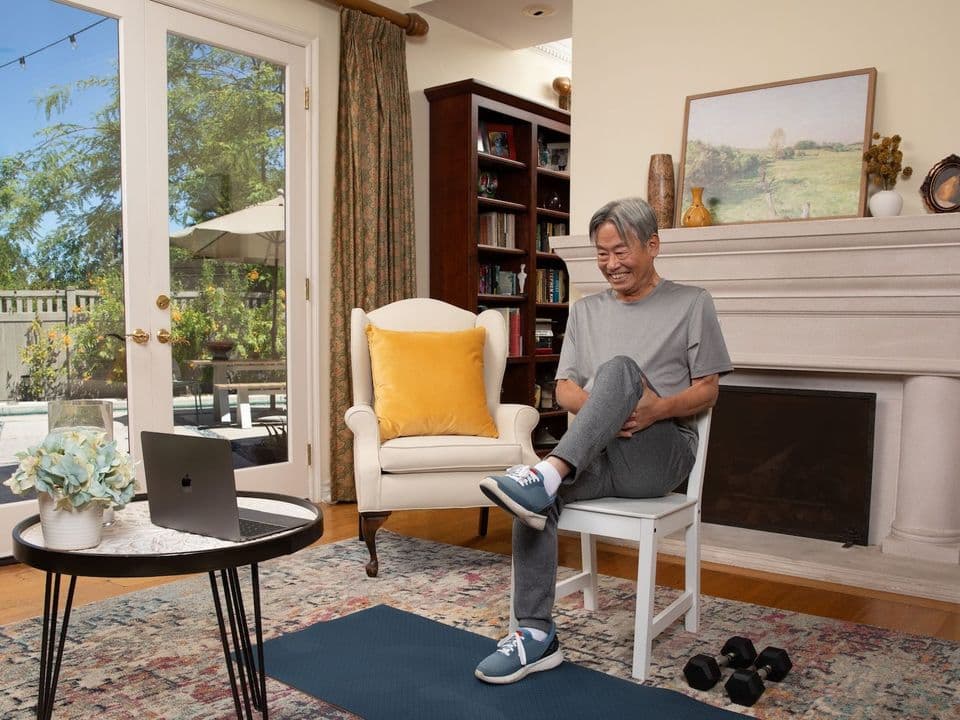
Seated figure four stretch
- Start sitting tall on the edge of a sturdy chair with your feet planted on the floor.
- Place your right ankle on your left thigh, just above your left knee, keeping your right knee out to the side.
- Gently press down on your right knee with your right forearm or slowly lean your torso over your legs to deepen the stretch.
- Hold for several breaths, then repeat on the other side.
Seated hamstring stretch
- Start sitting tall on the edge of a sturdy chair with your feet planted on the floor.
- Straighten your right leg and place your right heel on the floor, flexing your right foot. Place both hands on your left thigh.
- Lean your torso forward until you feel a stretch in the back of your right thigh.
- Hold for several breaths, then repeat on the other side.
Seated knee-to-chest stretch
- Start sitting tall on the edge of a sturdy chair with your feet planted on the floor.
- Clasp your hands together, and on an inhale, hold your right knee with both hands. Gently pull it toward your chest. Hold briefly. (You can also hold your leg behind your knee with both hands if that’s more comfortable.)
- On an exhale, lower your right knee to the floor.
- Repeat on the other side.
- Alternate for several rounds.
You can find these and other stretches to try in Bold’s 29 min Mobility: Joint Health.
Standing stretches for sciatica
Standing sciatica stretches require a bit more balance than seated stretches, but they prevent you from having to get down on the floor.
Standing hamstring stretch
- Start standing behind a sturdy chair or next to a wall to hold onto for balance.
- Keep a slight bend in your left knee and place your right heel on the floor, right leg straight.
- Hinge from your hips and lean your torso forward to feel the stretch in the back of your right thigh.
- Hold for several breaths, then repeat on the other side.
Standing pigeon pose
- Start standing in front of a table or high chair at about hip height.
- Rest your right shin horizontally on the table or chair. Hold onto it for balance if needed.
- Lean your torso forward to feel the stretch in your right buttock.
- Hold for several breaths, then repeat on the other side.
Standing figure four stretch
- Start standing behind a sturdy chair or next to a wall to hold onto for balance.
- With a slight bend in your left leg, place your right ankle just above your left knee.
- Push your hips back and bend your left knee until you feel a stretch in your right buttock, keeping your chest up.
- Hold for several breaths, then repeat on the other side.
You can find more standing stretches for sciatica to try in Bold’s 16 min Flexibility: Spinal Mobility for Low Back Pain.
Floor stretches for sciatica
If lying down on the floor is available to you, some sciatica stretches to try include the following.
Knees-to-chest stretch
- Start lying on your back on a mat or another comfortable surface, knees bent, feet on the floor.
- Hold your knees with both hands, either on top of or behind your knees.
- Gently pull your knees into your chest.
- Hold for several breaths.
Cat cow
- Start on your hands and knees, knees directly under your hips, palms directly under your shoulders.
- On an exhale, push your spine up toward the ceiling and allow your head to fall toward your chest, rounding your back into cat pose. Pause briefly.
- Slowly relax and let your stomach fall toward the floor, arching your back as you tilt your chin up into cow pose. Pause briefly.
- Continue alternating between the two for 30 to 60 seconds.
Child’s pose
- Start on your hands and knees on a mat or another comfortable surface.
- Bring your big toes together and your knees wider than your hips.
- Sit back to bring your buttocks down toward your heels, keeping your arms out straight in front of you, palms on the floor.
- Exhale as you lean your torso between your thighs, bringing your forehead to the floor if that’s comfortable for you.
- Hold for several breaths.
You can find more floor stretches for sciatica to try in Bold’s 9 min Flexibility: Spinal Mobility for Low Back Pain.
Adding stretches to your routine
It’s always a good idea to talk to a healthcare provider or physical therapist about the best way to add stretches to your routine. But generally speaking, sciatica stretches are typically safe enough that anyone can try them.
Once you’re cleared to try some exercises for sciatica on your own, find a convenient time for stretching that you can stay consistent with. For example, maybe you do five minutes of stretches for sciatica before you brush your teeth at night. If you already have an exercise routine, you can add a few minutes of stretching to the end of your other workouts.
Some people find stretching feels more comfortable if their muscles are warm first. This might look like walking or cycling for five to 10 minutes before stretching, especially if it’s first thing in the morning.
Aim to stretch at least two to three times a week. You can stretch every day if you feel like it and your healthcare provider says it’s OK. “Hold each stretch for about 30 seconds,” Estrada says. Make sure it feels like a gentle pull, not pain, she adds.
Ready to give it a try? You can follow along with lots of different sciatica stretches in Bold’s flexibility classes!
More classes to try:
Find sciatica relief with Bold
Bold's flexibility classes include seated, standing, and floor stretches to ease lower back and hamstring tension. Access them at home, at no cost, through your health plan.
More from Bold
The best stretches for seniors, explained
Discover the best stretches for seniors including hip stretches for flexibility, balance, and mobility. Learn when to stretch and get expert tips for safe, effective routines.

Hamstring exercises for seniors: Benefits and 12 exercises to try
Weak hamstrings cause back pain and raise fall risk. Discover 12 hamstring exercises for seniors including seated, standing, and floor options to build strength at home.

Webinar: Intro to Bold Care's Weight Loss Program
Watch this webinar to learn more about Bold's weight loss program, covered by Medicare, and how you can get started.