How to do a chair squat and why they’re so good for you
Chair squats build lower-body strength, ease knee pain, and support weight loss for older adults. Learn how to do a chair squat with proper form and variations to try.

Reviewed by
Key takeaways
- Chair squats are an effective lower-body exercise for older adults. They build strength in the glutes, quads, and hamstrings while also training balance.
- Chair squats can help with your ability to get up from chairs, climb stairs, and maintain independence in daily activities.
- Regularly practicing chair squats can also reduce knee pain over time by strengthening the muscles that support and protect the knee joint.
- Chair squats can support weight loss after 60. Because they work the glutes, quads, and hamstrings simultaneously (which are some of the largest muscles in your body), chair squats help you build lean muscle mass that keeps your metabolism active as you age. Your Bold provider can help create a personalized weight loss plan for you that includes a customer exercise program.
Squats are among the most functional strength-training exercises you can do. They help you with everyday movements like getting out of bed, standing up from the sofa, climbing stairs, and lifting heavy groceries.
But that doesn’t mean they’re easy. If you have knee pain or could use some additional support for your squats, you might want to start with a chair squat, also sometimes called a sit to stand.
Here, learn more about what makes chair squats great (they can help with everything from easing knee pain to supporting healthy weight loss for seniors), how to do one with proper form, and how to incorporate them into your workouts.
What are chair squats?
Chair squats are, as the name implies, squats you perform using a chair.
The chair acts as your own support system: It helps guide you into proper squat position, and it’s there for assistance.
In a chair squat, you’ll lower your body down as if you’re going to sit on a chair behind you. Then you’ll stand back up. Repeating this movement several times in a row (and then several times a week) helps strengthen the muscles in your lower body.
Benefits of chair squats
Like all types of squats, chair squats strengthen your quads, hamstrings, and glutes. Over time, this can help ease knee pain. That’s because when the muscles around a painful joint are stronger, they take some of the pressure off that joint.
Plus, when your lower-body muscles are stronger, you can handle daily activities like climbing stairs, picking something up off the floor, and getting out of the bathtub with more ease.
Chair squats are uniquely helpful in that they create a safety net: If you lose your balance or squat a little more deeply than you’re used to, you can always safely land in the chair before standing up again.
Some people also benefit from using the chair as a brief resting point, which might enable them to perform a few additional reps.
Chair squats also offer a unique advantage for seniors looking to lose weight. Because the movement engages the glutes, quads, and hamstrings at the same time, it's one of the most efficient exercises for building lean muscle. That matters because muscle tissue burns more calories at rest than fat tissue, so the more lean muscle you maintain, the higher your resting metabolic rate. For adults over 60, this makes chair squats a valuable part of any plan to lose weight without losing muscle. Unlike cardio-only approaches or restrictive diets, strength exercises like chair squats help you burn fat while holding onto the muscle that keeps you strong and independent.
How to do squats with a chair
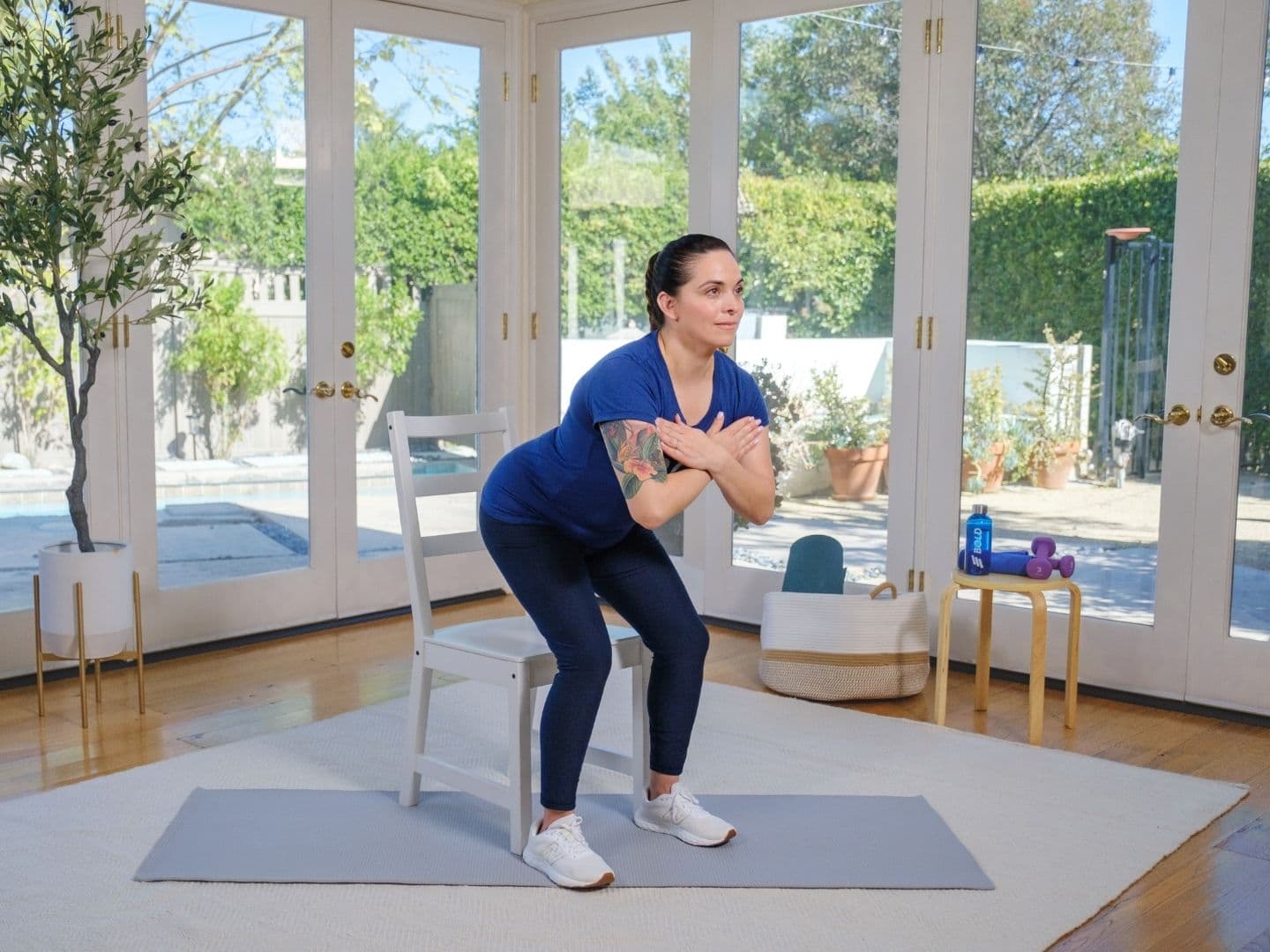
All you need to get started is a sturdy chair. Here’s how to do chair squats:
- Start standing in front of a sturdy chair with your feet shoulder-width apart, toes forward, arms by your side, knees in line with your feet.
- Push your hips back and keep your chest up as you bend your knees to lower your body until your glutes are hovering just above the chair (optional: Sit down on the chair if you’re more comfortable). Keep your chest up and your gaze forward.
- Press through your heels to return to standing. Squeeze your glutes and move your hips forward at the top.
- Repeat for all your repetitions.
Proper form and technique
Performing chair squats with correct form ensures you get the most out of each repetition and helps you avoid potential injury from doing an exercise incorrectly. Here are a few pointers to keep in mind:
- Start with your feet about shoulder-width apart, toes forward. If it’s more comfortable for you, you can turn your toes out very slightly — like they’re pointing toward 11 and 1 on a clock — or try a wider stance.
- Keep your knees in line with your toes. Do your best to not let them cave in toward each other.
- Keep your chest up and your gaze forward.
- If you need help with balance, place your hands on your hips or raise your arms straight out in front of your chest.
- Lower down slowly and with control. Stand back up with power.
- If you have trouble rising up from the chair, place a pillow on the seat, says Bold’s head trainer Alicia Rios.
- Use your hands for assistance by pushing off of the chair. “As you get stronger, you can use only one hand, and then no hands,” Rios says.
Common mistakes to avoid
The chair will help you avoid one common squat mistake: not going low enough. With the chair as a reference point, you’ll hit the right squat depth. “Make sure to complete the full range of motion,” Rios says. “As you stand, return to the full starting position. If you sit down on the chair, sit all the way down. If you just touch your glutes to the edge of the chair, make sure to tap the chair and immediately rise back up.”
Other mistakes to look out for include:
- Letting your knees cave in
- Leaning your chest too far forward
- Starting with your feet too close together or far apart
- “Don't let your heels touch the legs of the chair,” Rios says. “Keep your feet a few inches away from the chair legs for better stability.”
Any of these can limit your range of motion, increase your risk of injury, and get in the way of your progress.
Try a chair workout today
Bold offers a full library of senior-friendly chair exercise classes, designed to build strength, improve balance, and support overall health.
Chair squats workout
Chair squats can fit into any number of different workout routines, such as lower-body workouts, full-body workouts, and seated workouts. In fact, you can find lots of routines to follow along with on the Bold exercise platform that include chair squats!
Sample workout routine
Here’s what a full-body chair workout might look like:
- Warm-up exercises
- Calf raises
- Leg extensions
- Chair squats
- Seated crunches
- March with seated biceps curls
- Cool-down stretches
You can find workouts like these in Bold's online classes. Follow along two to three times a week, with at least two days in between. Consistent strength training is especially important if weight loss is one of your goals. Regular sessions build the lean muscle that keeps your metabolism working for you between workouts. Bold can help you with creating a personalized weight loss plan that includes a weekly exercise routine: agebold.com/weight-management.
Chair squat variations
With enough practice, you may notice chair squats start to feel less challenging. That’s a sign it’s time to increase intensity with this movement. Otherwise, you may not continue to make progress toward your strength and balance goals.
When you’re ready, you can try some squat variations without the chair. Here are a few to try:
- Kitchen sink squats: Instead of squatting over a chair, hold onto the edge of a sturdy piece of furniture like the kitchen sink as you push your hips back and lower down.
- Wall squats: Perform your squats with your back against a wall. Lower down until your thighs are parallel to the floor, or as low as you can comfortably go with proper form.
- Bodyweight squats: Do your squats without any props and instead use just your bodyweight.
Single-leg chair squat
You can also keep the chair exactly where it is and make this exercise harder by keeping your weight on one leg at a time. This can help you correct any strength imbalances you have on one side of your body. It also recruits more of your core to help you stay upright and work on your balance.
Single-leg squats are challenging for most exercisers at any age. Many people use a chair while they build up the strength to one day be able to do this move without extra support.
Here’s how to do it:
- Start standing in front of a sturdy chair with your feet shoulder-width apart, toes forward, arms by your side. Raise one foot off the ground.
- Push your hips back and keep your chest up as you bend your standing knee to lower your body until your glutes touch the chair.
- Press through your standing foot to return to start.
- Repeat for all your reps, then switch sides.
Adding resistance
Another way to make chair squats workouts more challenging is to add resistance for your muscles to power through.
This will typically look like holding a weight while you squat, such as:
- Holding a dumbbell (or a household item like a water bottle or a can of food) in each hand by your sides
- Holding a dumbbell, kettlebell, or weight plate (or a household item like a jug of laundry detergent) at your chest
- Wearing a weighted vest
Start wherever you’re comfortable, and build up to adding resistance over time. Bodyweight chair squats and other seated exercises can help you build strength, improve balance, lose weight, and ease pain.
Chair squats work best as part of a full lower-body or full-body routine. Pair them with glute exercises like glute bridges to strengthen the backs of your hips, and chair sit-ups to build core stability. Adding calf raises and leg extensions rounds out a balanced seated workout that targets every major lower-body and core muscle group.
Yes, chair squats can support weight loss for adults over 60. The movement works your glutes, quads, and hamstrings at the same time (these are three of the largest muscle groups in your body). Building strength in these muscles raises your resting metabolic rate, meaning you burn more calories throughout the day. It's one of the most effective ways to lose weight without losing muscle as you age. Bold can help you with creating a personalized weight loss plan that includes a weekly exercise routing: agebold.com/weight-management.
Once bodyweight chair squats feel comfortable, you can add resistance by holding a dumbbell in each hand at your sides or a single weight at your chest (a position called a goblet squat). Using household items like water bottles or cans work too. Start light and increase gradually. Adding weight helps you build more lean muscle, which boosts your resting metabolism and supports weight loss for seniors.
All you need is a sturdy, stable chair and enough space to stand and sit comfortably. Place the chair on a non-slip surface and make sure it won't slide backward as you lower down. No other equipment is required. You can follow along with a Bold lower-body strength class for guided instruction and a full workout built around movements like the chair squat.
Start with just a few repetitions — even three to five is a good beginning — and focus on form rather than quantity. Sit all the way down onto the chair and use your hands to push off if needed. As you get more comfortable, try hovering just above the seat before standing back up. Build up gradually over several weeks, aiming for two to three sessions per week.
Start by choosing a sturdy chair that won't wobble or roll. If standing back up is difficult, place a pillow on the seat to reduce how far you need to lower. You can also push off the chair with your hands at first, then progress to one hand and eventually no hands as you build strength. Always check with your healthcare provider before starting a new exercise.
Proper form means keeping your knees in line with your toes, your chest lifted, and your weight in your heels, not your toes. A common mistake is leaning too far forward, which puts strain on your lower back. If balance is a challenge, place your hands on your hips or extend your arms in front of your chest. Lower yourself slowly and with control, then stand back up with power.
Stand in front of a sturdy chair with your feet shoulder-width apart and toes pointing forward. Push your hips back and bend your knees to lower yourself until your glutes hover just above the seat, or sit down briefly if you prefer. Keep your chest up and your gaze forward throughout the movement. Press through your heels to stand back up and squeeze your glutes at the top.
Weight loss for seniors
Book an appointment with a Bold Care provider to lose weight, reduce pain, and get your energy back. Your plan includes nutritional support, exercise programming, and $50 monthly copay FDA-approved GLP-1s, if prescribed.
More from Bold
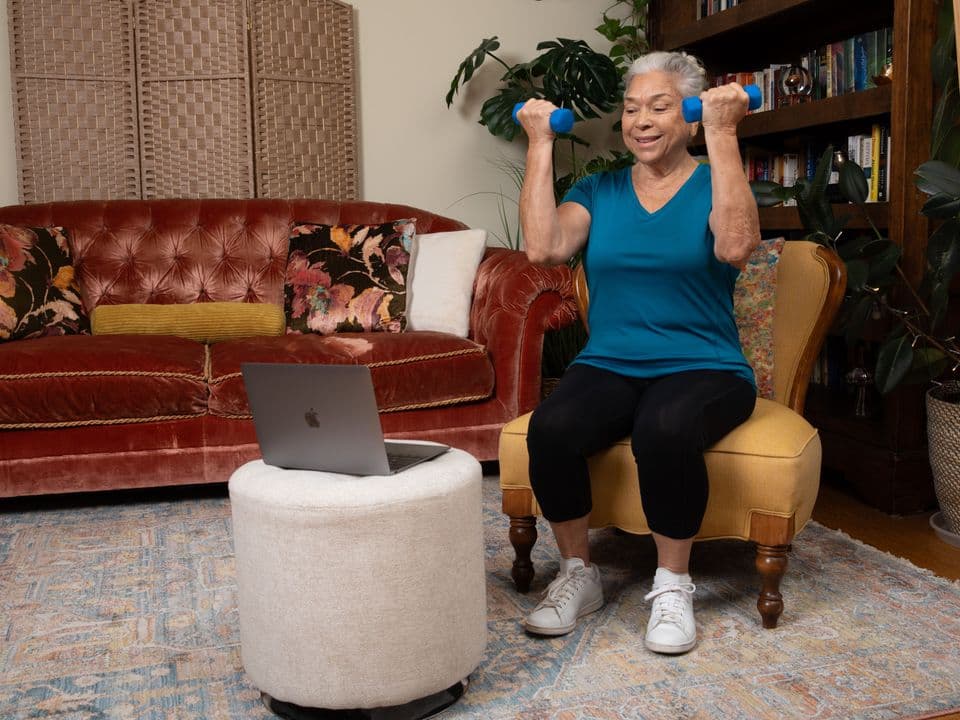
5 exercises you can do from your chair
Discover 5 senior-friendly chair exercises to build strength, boost flexibility, and support healthy aging, all from the comfort of a sturdy chair.
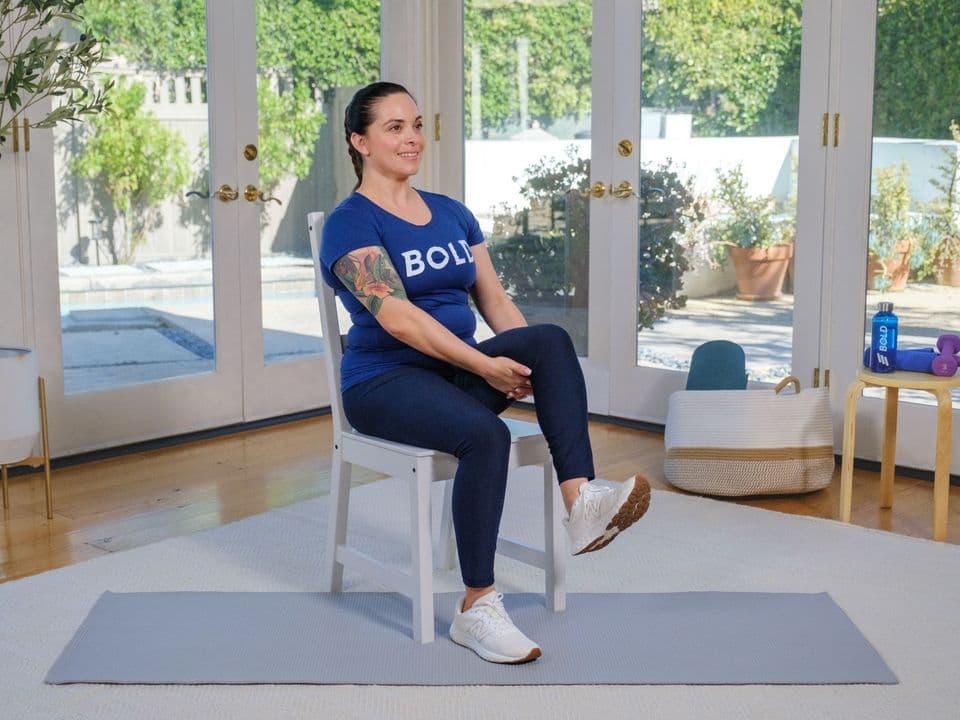
4 senior-friendly chair exercise classes
Explore four senior-friendly chair exercise classes from Bold designed to improve balance, strength, and heart health.
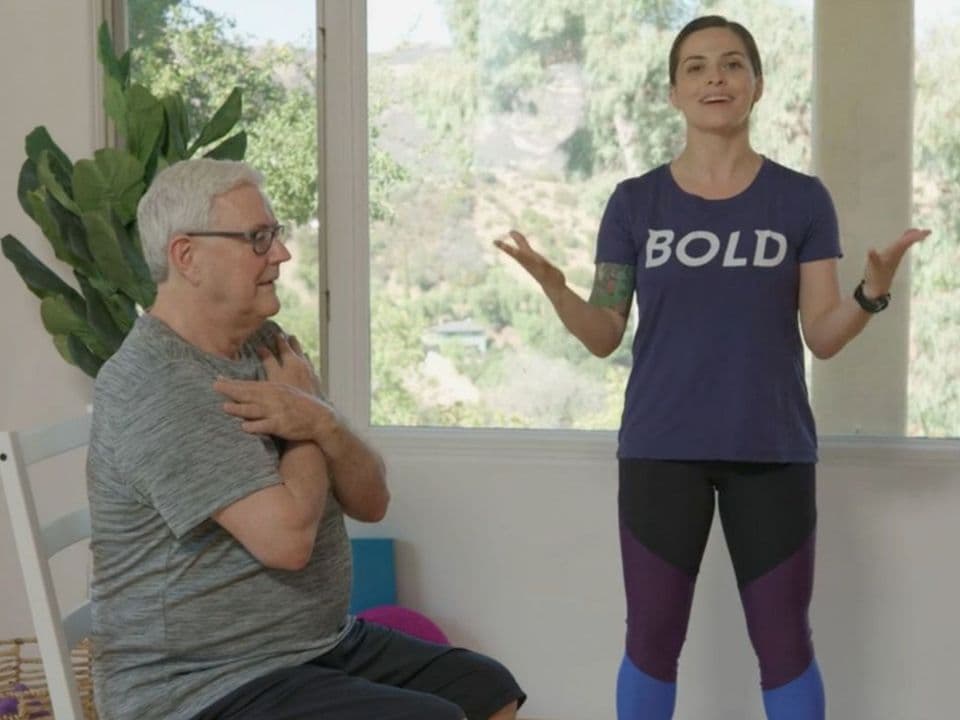
Chair workouts for seniors: Your top 5 questions, answered
Discover the benefits of chair workouts for seniors: build muscle, improve balance, and stay safe while seated. Get started with simple exercises at home.