Glute exercises for seniors: The best moves to try and why they’re so good for you
Glute exercises for seniors ease pain, prevent falls, and support weight loss for older adults by building muscle. Learn the best moves and how to start.

Reviewed by
Key takeaways
- The glutes are the largest muscles in the body. They power nearly every lower-body movement, from standing up to climbing stairs. Weak glutes can lead to knee injuries, back pain, and poor posture.
- Strong glutes improve balance and reduce fall risk. They stabilize the pelvis and hips during single-leg movements like walking and stair climbing, and take strain off the knees and lower back.
- Glute exercises come in many forms. Seated options like the seated march and seated band abduction work for any fitness level. Squats and glute bridges add more challenge as you build strength.
- Pair glute strengthening with mobility work. Tight hips often go with weak glutes. Stretches like the figure four, knee-to-chest, and low lunge help maintain hip range of motion and get the most out of your glute training.
- Glute exercises support healthy weight loss after 60. Because the glutes are the body's largest muscle group, building strength in them raises your resting metabolic rate, helping you lose weight without losing muscle, which is especially important for adults over 60.
Strong glutes help you do just about everything. You use your glutes (the muscles of your buttocks) to stand up from a chair, get out of bed, and walk up stairs. They allow for forward movement, support sitting and standing posture, and keep your lower-body joints mobile, protecting your independence as you age. And because the glutes are the largest muscle group in your body, strengthening them can also play a key role in weight loss for seniors by boosting your resting metabolism.
But building strength in these key muscles takes some dedication. Keep reading to learn everything you need to know about glute exercises for seniors.
What are your glutes?
“Glutes” is short for gluteus muscles. These thick muscles are the largest in your body — and the ones you sit on. There are three gluteus muscles on each side of your buttocks.
Anatomy of glute muscles
The three gluteal muscles are the gluteus maximus, medius, and minimus.
- Gluteus maximus: Responsible for extending and externally rotating your hip, meaning it pushes your leg back behind you when you move. It’s the largest of the glute muscles that makes up most of the shape of your backside.
- Gluteus medius: Smaller than the gluteus maximus, responsible for moving your leg away from your body and internally and externally rotating your hip.
- Gluteus minimus: The smallest glute muscle, responsible for moving your leg away from your body and internally and externally rotating your hip with the gluteus medius.
Benefits of glute exercises for seniors
Just about everyone can benefit from stronger glutes. But there are specific perks for older adults to consider.
Injury prevention
When your glutes are weak, your body may naturally compensate with the muscles in your legs or back. Over time, relying on these compensations can lead to knee injuries and back pain. “Strong glutes help support and align the pelvis and lower back, improving performance and making everyday activities easier and safer,” says Bold head trainer Alicia Estrada. “By strengthening these muscles, you enhance core stability, promote better movement patterns, and reduce the risk of injury.”
Pain management
If you already have existing hip or back pain, glute exercises might help.
Strong glutes help stabilize and support your pelvis and lower back so you’re less likely to feel pain there. Building strength in these muscles also takes some of the strain off of your hips and knees, alleviating pain.
Posture
Glute exercises help your pelvis and spine stay aligned, supporting proper posture. “This allows your body to move more freely and efficiently, reducing strain on the lower back and hips,” Estrada says. “Over time, this translates into better posture and easier, more confident movement.” Poor posture can also contribute to wear and tear on your muscles and joints and lead to lower back pain.
Hip mobility
Weak glutes can also affect your hip mobility, potentially leading to injuries or pain. Strengthening these muscles keeps your hips stable and powers your ability to move through your full range of motion.
When you spend a lot of time sitting, your glutes naturally get weaker and your hips naturally get tighter. So it’s important to pair glute exercises with hip and glute stretches for optimal hip mobility (more on that below!).
Balance and fall prevention
Because having strong glutes improves hip mobility and pelvis stability, you’ll feel more balanced during single-leg movements like walking or climbing stairs. That’s important for avoiding falls, which are a major source of injury for older adults. Better balance can also help you avoid injury during active moments, like a game of tennis or pickleball.
Weight management
If you're wondering how to lose weight after 60, strength training (especially exercises that target large muscle groups like the glutes) is one of the most effective strategies. Muscle tissue burns more calories at rest than fat tissue, so building stronger glutes can raise your resting metabolic rate and help your body burn more calories throughout the day.
This is especially relevant for older adults because we naturally lose muscle mass as we age, a process called sarcopenia. That muscle loss slows your metabolism and can make it harder to maintain a healthy weight. Glute exercises help you fight back: they build and preserve lean muscle so you can lose weight without losing muscle. That's critically important, because crash diets and cardio-only approaches often lead to muscle loss alongside fat loss, leaving you weaker and more prone to injury.
Pairing glute-strengthening exercises with a balanced diet is a sustainable approach to weight loss for seniors, one that protects your strength, mobility, and independence all at the same time. If you’d like to read about getting enough protein after age 60, explore our Protein Guide for Adults 60+.
Weight loss for seniors
Book an appointment with a Bold Care provider to lose weight, reduce pain, and get your energy back. Your plan includes nutritional support, exercise programming, and $50 monthly copay FDA-approved GLP-1s, if prescribed.
Top glute exercises for seniors
There are lots of different strength training exercises for glutes that are appropriate for older adults. “Consider a movement that limits stress on your joints and one you can practice safely,” Estrada says. “Aim for exercises that strengthen without strain and support steady progress over time.”
Here, we’ll cover seated glute exercises, squat variations, glute bridge variations, and mobility exercises for glutes. But you can find many other glute exercises to try in Bold’s lower-body strength classes.
Seated glute exercises
Seated glute exercises are an accessible option for people with trouble balancing or difficulty standing or getting up from or down on the floor. Here are some of our favorites.
Seated band abduction
- Start sitting on the edge of a sturdy chair with your feet planted on the floor with a mini loop resistance band positioned above your knees.
- Keeping your feet on the floor, press your knees away from each other as wide as you can.
- Slowly and with control, return your knees to center, keeping tension on the band.
- Repeat for several repetitions.
Seated march
- Start sitting on the edge of a sturdy chair with your feet planted on the floor.
- Raise one knee at a time toward your chest like you’re marching.
- Alternate legs for several rounds.
Seated glute stretch
- Start sitting on the edge of a sturdy chair with your feet planted on the floor.
- Place your right ankle on your left thigh, just above your left knee, keeping your right knee out to the side.
- Gently press down on your right knee with your right forearm or slowly lean your torso over your legs to deepen the stretch.
- Hold for several breaths, then repeat on the other side.
Get started with seated glute exercises for seniors in Bold’s 21-Min Strength: Lower Body Resistance class.
Types of squats for glutes
Squats are some of the most functional glute exercises because they help you build strength to stand up from sitting, climb stairs, and more. They’re also great glute max exercises, helping you build strength in the biggest muscle in your buttocks.
There are squat variations for just about everyone. You can do squats using a chair for support, with just your body weight as you build strength, and with additional resistance like dumbbells, kettlebells, and barbells as you get even stronger.
Chair squats
Chair squats are squats you perform using a chair for guidance and support.
- Start standing in front of a sturdy chair with your feet shoulder-width apart, toes forward, arms by your side, knees in line with your feet.
- Push your hips back and keep your chest up as you bend your knees to lower your body until your glutes are hovering just above the chair. You can also sit down on the chair if that’s more comfortable. Keep your chest up and your gaze forward.
- Press through your heels to return to standing. Squeeze your glutes and move your hips forward at the top.
- Repeat for all your repetitions.
Bodyweight squats
Bodyweight squats are squats you do without any extra equipment. The movement is very similar to the chair squat, but you do it without anything to support you.
- Start standing with your feet shoulder-width apart, toes forward, arms by your side, knees in line with your feet.
- Push your hips back and keep your chest up as you bend your knees to lower your body until your thighs are parallel with the floor or as low as comfortable. Keep your chest up and your gaze forward.
- Press through your heels to return to standing. Squeeze your glutes and move your hips forward at the top.
- Repeat for all your repetitions.
Goblet squats
Goblet squats are typically done in a wider stance with your feet and holding a moderate to heavy dumbbell or kettlebell at your chest. This can help target different glute muscles and improve range of motion in the hips for some people. “It can allow you to stand with a wider and more comfortable stance, putting less stress on the knees and back,” Estrada says. “Holding the weight by your chest also reminds you to stay upright rather than leaning forward.”
- Start standing with your feet wider than hip-width apart, toes pointing out slightly, knees in line with your feet, holding a moderate to heavy dumbbell or kettlebell in both hands at your chest.
- Push your hips back and keep your chest up as you bend your knees to lower your body until your thighs are parallel with the floor or as low as comfortable. Keep your chest up and your gaze forward. Keep your elbows inside your knees.
- Press through your heels to return to standing. Squeeze your glutes and move your hips forward at the top.
- Repeat for all your repetitions.
Build up your strength for squats in Bold’s 18-Min Strength: Squats class.
Glute bridge variations
The glute bridge is another go-to glute exercise to try that you can do without any equipment. There are several glute bridge variations you can try, depending on your experience and fitness level. Glute bridges typically require you to be able to get down on the floor, so they may not be suitable for all exercisers.
Standard glute bridge
- Start lying on your back with your knees bent and your feet on the floor. Your arms can be by your sides.
- Tuck your pelvis and press through your heels to lift your hips until your body forms a diagonal line from knees to hips to shoulders. Squeeze your glute muscles at the top.
- Slowly lower your hips back to the floor.
- Repeat for several repetitions.
Single-leg glute bridge
If you’re ready for more of a challenge, you can try a glute bridge on just one leg at a time. This helps isolate your glute muscles and requires more balance from your core.
- Start lying on your back with your knees bent and one foot on the floor, the other foot raised. Your arms can be by your sides.
- Tuck your pelvis and press through your heel to lift your hips until your body forms a diagonal line from your hips to your shoulders. Squeeze your glute muscles at the top.
- Slowly lower your hips back to the floor, keeping your elevated leg raised.
- Repeat for several repetitions, then repeat for the same number of repetitions on the other side.
Elevated glute bridge
Sometimes also called a hip thrust, an elevated glute bridge gives your hips a larger range of motion and allows you to add weight to the classic bodyweight exercise.
- Sitting on the floor with your upper back and arms on something sturdy like a coach or a bench. Plant your feet hip-width apart. Optional: Hold a dumbbell on each hip.
- Tuck your pelvis and press through your heels to lift your hips until your body forms a straight line from knees to hips to shoulders. Squeeze your glute muscles at the top.
- Slowly lower your hips back to the floor.
- Repeat for several rounds.
Get started with Bold’s 2-Minute How-To: Bridge video.
Mobility exercises for glutes
It’s common for people with weak glutes to also have tight hips, often because the hip flexors overcompensate for the glutes or because of prolonged sitting.
It’s a good idea to incorporate some mobility work into your glute workouts or your overall workout routine. “It is crucial to activate the glutes through a combination of mobility exercises, strength training, and stretching,” Estrada says.
Mobility work that complements glute exercises will involve stretching the hips, glutes, and hamstrings, as well as gentle hip, knee, and glute exercises that take your joints through their full range of motion without adding weight.
Try to do mobility exercises at least two to three times a week. Some example movements and stretches might include:
- Clamshell
- Figure four stretch
- Low lunge stretch
- Knee-to-chest stretch
- Hamstring stretch
Check out Bold’s 6-Minute Mobility: Hips video for some mobility movements to start with.
Exercise routine for glutes
Ready to build the perfect exercise routine for glutes? Start by checking with your healthcare provider to make sure glute exercises are safe for you. Depending on your situation, they may recommend avoiding certain movements. You can also speak with a physical therapist about creating an exercise routine for glutes with the best glute exercises for you.
Once you’re cleared to exercise on your own, make sure you have a comfortable, safe space where you can move at home.
Choose from any of Bold’s lower-body strength classes to find glute exercises like those above and more.
The CDC recommends adults 65 and older aim for at least two days a week of strength training. Each workout should include a couple of exercises that target your gluteus muscles. Over time, you can gradually build up to more strength workouts per week if you want. Consistency is especially important if weight loss is one of your goals. Regular glute training helps you build and maintain the lean muscle mass that keeps your metabolism active as you age.
Listen to your body as you follow along with the class. Take breaks when you need to, to sip some water, catch your breath, or make sure you’re in the proper position.
Equipment for glute workouts
You can do lots of glute exercises using just your body weight without any equipment.
If you’re going to try seated glute exercises, make sure you choose a sturdy, stable chair that won’t wobble or roll.
When you’re ready to add more resistance to your glute exercises, you might experiment with any of the following equipment:
- Mini loop resistance bands
- Dumbbells
- Kettlebells
- Barbells
- Weight plates
- Weighted vests
Remember, like with any type of exercise, it’s important to start where you’re comfortable with glute exercises and build up slowly. In the process, you’ll notice improvements in strength, balance, posture, and more. Follow along with a Bold exercise class today!
More glute classes to try:
- 34-Minute Strength: Lower Body Essentials
- 20-Minute Strength: Lower Body Builder
- 23-Minute Strength: Lower Body Mobility
The key to losing weight without losing muscle is combining strength training with a balanced diet. Glute exercises are especially effective because they target the body's largest muscles, helping you preserve and build lean mass while creating a calorie deficit. Avoid crash diets or cardio-only approaches, which can accelerate muscle loss. Consistency with strength training two or more days per week makes the biggest difference.
Yes, glute exercises can support weight loss for seniors. The glutes are the largest muscle group in your body, so strengthening them increases your resting metabolic rate, meaning you burn more calories even at rest. For adults over 60, this is one of the most effective ways to lose weight without losing muscle, which is critical for maintaining strength, balance, and independence. Bold can help you with creating a personalized weight loss plan: agebold.com/weight-management
Glute strengthening exercises are any movements that build strength in your glute muscles through resistance, whether that's body weight, bands, or dumbbells. The term overlaps with glute exercises generally, but strengthening specifically means you're working the muscles hard enough to build or maintain muscle mass. That's especially important for seniors, since preserving lean muscle supports metabolism, balance, and mobility.
The seated march and chair squat are two of the easiest glute exercises for seniors to start with. Both use a chair for support and require no equipment. Glute bridges are another beginner-friendly option if you're comfortable getting to the floor. Start with a few repetitions, focus on proper form, and gradually increase as you build strength and confidence.
Squats are one of the most effective standing glute exercises for seniors. Chair squats offer support for beginners, while bodyweight and goblet squats add challenge as you build strength. Standing glute exercises are especially helpful — they train the same movement patterns you use to stand up, climb stairs, and walk, helping you stay independent in daily life.
Seated marches, seated band abductions, and seated chair squats are all effective seated glute exercises for seniors. These moves let you strengthen and stretch your glutes from a chair, making them ideal if you have balance concerns or difficulty getting on the floor. They're a great starting point for building the strength you need to progress to standing or floor-based exercises.
Seated exercises like the seated band abduction are among the best options for seniors with bad knees. These movements strengthen your glutes without placing heavy stress on the knee joint. Stronger glutes also help support and align your knees over time, which can reduce knee pain. Always check with your healthcare provider before starting a new exercise routine.
Yes, most glute exercises for seniors can be done at home with little or no equipment. Seated marches, chair squats, and glute bridges all require just a sturdy chair or floor space. As you get stronger, you can add mini loop resistance bands or dumbbells. Bold's online lower-body strength classes are designed to guide you through glute exercises at home at your own pace.
Weight loss for seniors
Book an appointment with a Bold Care provider to lose weight, reduce pain, and get your energy back. Your plan includes nutritional support, exercise programming, and $50 monthly copay FDA-approved GLP-1s, if prescribed.
More from Bold
Hamstring exercises for seniors: Benefits and 12 exercises to try
Weak hamstrings cause back pain and raise fall risk. Discover 12 hamstring exercises for seniors including seated, standing, and floor options that build strength and support weight loss for older adults.
Hip exercises for seniors: Benefits, stretches, and strengthening tips
Ease hip pain and improve mobility with simple exercises designed for seniors. Discover seated, standing, and floor moves to build strength and stay active.
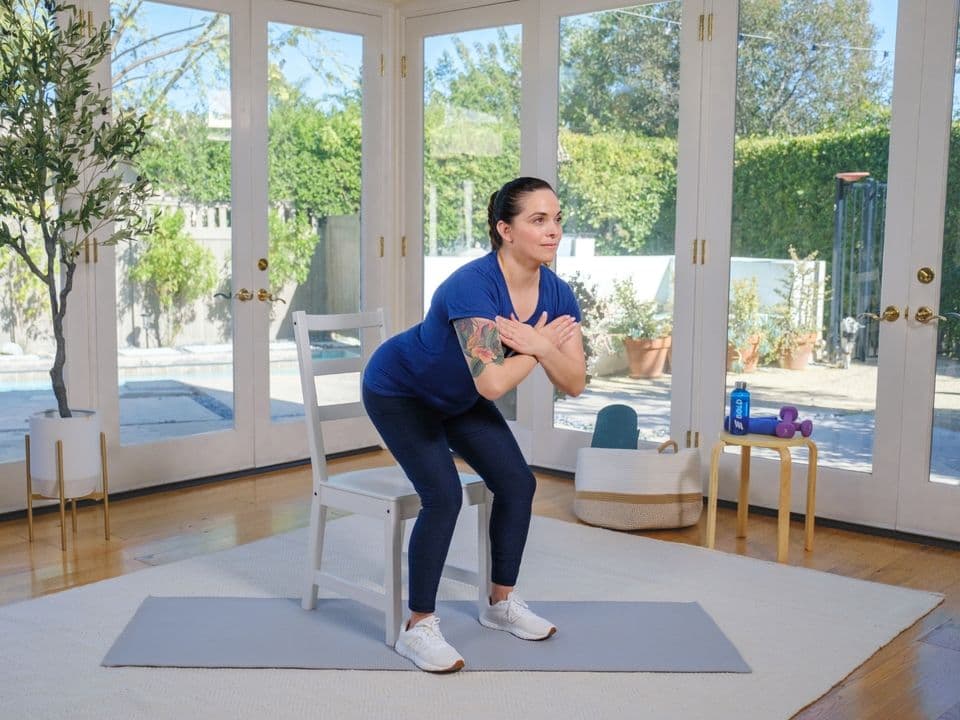
How to do a chair squat and why they’re so good for you
Chair squats build lower-body strength, ease knee pain, and support weight loss for older adults. Learn how to do a chair squat with proper form and variations to try.